Saturday, 19 March 2016

How to become French - Part 2. Naturalisation interview

On a fresh but sunny Thursday JC drove me the two hours to Tours for a date with destiny (one way or the other).

I had an interview, at the prefecture, for naturalisation to become a citizen of France (and Europe).
I'd been preparing for this for weeks and was feeling very stressed. Days and nights had been spent swotting the Livret du Citroyen contents. JC had tested me on possible questions but I couldn't seem to make the dates and foreign names stick in my head. I knew much more than what was in the book but it wasn't me in charge of the questions and, in fact, any random question could be asked.

I'd trawled the internet forums for what I might expect. Some said it was pretty easy and the interview lasted only 10 minutes (really?). Others were served balls from left field by being asked to write letters in French or list a lot of ex-colonies, sporting heros, singers etc. In this case you can never really be prepared.

Still, I could prove my love and participation in France and things French. I took along a copy of my book, Follow my Heart: Risking it all for a life in France. I also brought along a book on French history, in French and with a message from a friend saying it was a present in recognition of my love of France. The rest of my very heavy bag was full of books I've created over 5 years showing French culture, history, my family ties to France, and 4 books relating to my relationship with JC. The latter were never used in the interview. And I knew how I felt about things. I also switched on my Toastmasters training and Communications training because this so-important interview was in French and my competence was being yet again assessed, in a live situation rather than a 'test'.

I didn't sleep well the night before. My nerves were at such a pitch that when I arrived at Tours and got out of the car I discovered I was wearing two different pairs of boots. One for each foot. Quelle horreur! No wonder I was walking with a funny gait. One boot had a heel higher than the other. At least the boots were on the correct feet and were both black. Mortified, there was nothing I could do about it.

Official documents I had to bring included:
  1. The latest list from the trésorie of my tax payments (the previous one with my demand for naturalisation was now no longer current)
  2. My current carte de Sejour
  3. My interview confirmation
  4. My work contract
  5. The last three payslips from my job.
The lady was pleasant and meticulous. There was to be no informal 10 minute chat with me. She took the entire hour covering many different areas of my life and activities. Some questions were unexpected, such as what period of history did I consider most important and why did it interest me? I plumped for the Renaissance and a little earlier. This being Tours, the chateaux of the Loire were mostly built during the Renaissance. She asked me to name them and talk about them. Sure I know heaps but under pressure, in French, one wonders just what one can say in a short time to convince someone I know stuff. Luckily I keep myself up to date on many things, such as the fact that much of Azay-le-Rideau is under scaffolding right now due to important renovations and that the hunting dogs of Cheverny are a special feature of a visit there.... And in fact there's a nice chateau near me called the Chateau de Maintenon (owned by Louis XIV's second wife) which I have visited many times.

She asked me what level of French I had arrived with. I told her I'd studied it in High School such  a long time ago so although I understood the grammar I was very weak in anything oral, but one must make an effort to improve because the language and the culture are entwined. You cannot have one without the other.

She spent some time looking at my two passports, the current one and especially the cancelled one. In France you don't get to keep your old passport. I brought the cancelled one along because it has my visa in it and also the sticker from the immigration department.
Of course, the predictable question of why I wanted to become French arrived. It's not that easy to explain the intangible but I did my best and showed her how I tried to live my dream. I also explained that I was currently very limited by what sort of work I was allowed do on my visa. I'd like more options to use more of my talents. I'd made a commitment to France - I'd like France to make one to me. She asked if I had already decided to ask for naturalisation when I arrived in France. I replied no. To begin it was simply to realise my dream and have an adventure but that quite soon it became essential for me ; mind, body, soul to become French, officially, because in my heart and soul I already felt French, well, look at my name and my ancesters. My middle name Suzette is totally French.

Explain the rights and responsibilities of a French citizen. I barely got started on that.
Discuss the concept of égalité. I thought that might be a good moment to mention that NZ was the first country to give women the right to vote. She asked me how I'd feel about having a female president. I said I wouldn't comment on Marine le Pen but females in such roles seemed completely normal to me. Life in NZ is democratic.

I had an active associative life? I explained I was a member and the translator for the Association d'Epernon Patrimone et Alentours. Being a member of community associations or groups is key in an interview such as this. I had also attended several meetings of the Business Women's Network at Chartres, including the recent visit by the international president.

I must have a lot of friends? Not a lot but the ones I have are all my age, except for the lady who had signed the present to me. I explained my job is very solitary and I wished I had more colleague contact.

And then one of the critical interview questions... How many times had I been back to NZ?
Never! She seemed taken-a-back. Never? Not ever, I said. I've brought my daughter here to see France a couple of times but she has her own life in Auckland and is getting married, and my mother has dementia so any conversation with her is difficult.

I didn't mention a planned trip had been cancelled. I didn't mention I had no money for regular trips, and anyway I don't miss NZ as much as I appreciate it; just some people and the ease of language.

It seemed to her, she said, that it was a bit pointless asking me much about history or culture. I was asked very little that was in the book. I was all ready to tell her how many communes, how many départements, quote endless authors, poets, musicians, scientists - I wasn't asked. When she'd say there was no point asking me a certain thing  (because it seemed I was pretty boned-up on that) I just gave the 'gallic shrug' and gave her some info anyway. I did explain laicité to her and that I was not religious.

The conversation felt very stilted because there was a time limit and I had no idea how many questions she would ask. I could have said more on each subject but I didn't want to sabotage myself by making a mistake. She made notes in thick red ink in the margins of her document. Unlike some accounts on the online forums, she gave me no indication at all if I would be successful. She simply stated that this stage of the process, having an interview, was now complete. My dossier would be sent to the prefecture at Chartres. I would be called up for a visit by the Gendarmerie at Chartres where I would be interviewed again. Then the dossier would be sent to Nantes and there would be a long wait; I probably wouldn't hear anything this year. I would know sometime in 2017.

It wasn't the last I heard from her. During the interview I had asked her why Marianne? Why was she, a female, the symbol of the French Republique? Was it because république and liberté are feminine nouns? She didn't know and rummaged through some papers. Then she asked me for my email address, which surprised me greatly. I said not to worry, I could probably find it on the internet, but she insisted. Three hours after the interview I found a message from her in my inbox. I was right, she said, and had copy/pasted a text confirming it. JC felt this was a postive sign that she thought I was worth making a personal effort for. Maybe he's right but the final decision isn't hers. Another stage completed. I await contact from the gendarmes.

For all of those of you interested or actually awaiting such an interview I hope this account helps. Expect to be nervous but hang in there, speak from the heart and you'll know you've done your best. And, read the Livret as a precaution.


Saturday, 20 February 2016

How to become French - Part 1.5

I've been waiting and wondering for four months. What's happened to my application for naturalisation? I think about it every day, and today JC came in from the letterbox with an official envelope from the prefecture of Indre-et-Loire (Tours). Inside was a letter confirming my application and instructions on how to go online and request an interview.                           Yay, I now have a dossier number. Also included was a copy of the Livret du Citroyen, a handbook on the rights, responsibilities of citizens and possible subject areas I could be tested on at the interview. Many people have indicated it's a grilling or interrogation to test your determination to become French and your command of the French language as well as whether you are of the 'right stuff' to be considered a French citizen.
I shall be studying this book before JC starts testing me on the contents. It's one thing to swot up something but another to do it all in a foreign language, hence the nerves everyone suffers from (except those who are bilingual, which I will never be). Technically I have more than enough competence in French to be accepted but... it has to be tested in person under stress and will include questions of a personal nature designed perhaps to throw me off my guard - well, I've heard that.

My knowledge of French history should be fine as I seem to know more than my French students and I understand the three principles of the Republic but there's plenty else they can ask that isn't in the book though the book is well presented and interesting. I shall spend this weekend swotting the book and then sometime next week I have to go and request yet more documents (especially relating to payment of all taxes over the years) to take to the interview. What I have already supplied is now considered out of date. At the same time I will organise the date of the interview. Maybe I will have to go to Tours which is nowhere near where I live but rather in the heart of the region full of historic chateaux. We'll see.
Next step: get the interview appointment. In the meantime I continue to keep my university students on task and JC is occupied having the tree stump dug out while he collects and then slices with his chainsaw, the branches of the tree he had felled recently.  
I'm very impatiently awaiting Spring and the re-creation of my potager. Each time I tuck into a jar of my delicious home-made beetroot relish I'm reminded of the organic bounty a well-composted French potager can provide. If only they wanted to talk about gardening at the interview...


Wednesday, 13 January 2016

French Army Museum - Les Invalides - Paris

Founded by Louis XIV in 1670 to house wounded and retired war veterans, it houses an astonishing collection of military items.

With such a rich history in the middle of Europe it's not too surprising that France has such an extraordinary collection of war history yet it's only a quarter of what there was before the revolution. So many precious items were stolen, sold or dispersed, destroyed at that time. However the collection of 500,000 arms, suits of armour, artillery pieces, decorations, emblems, uniforms, paintings and photographs is pretty impressive. Covering more than 900 years it's amazing to see how technology evolved; some of the ancient weapons are surprising in their mechanical complexity.

The arquebus, the cannon, the pistol, the rifle, the sabre and the epee, the elegant and deadly swords. Seige weapons and modern warfare also feature. It's an extensive display in a beautiful building. I also visited one of their temporary exhibitions Knights and Bombards there. It was well done and I especially liked the thought that had gone into preparing little worksheets for children to make information scavenger hunts throughout, in English too. I enjoyed seeing the illustrated books and even real treaties from renaissance times. The battle of Agincourt in 1415 featured strongly, even if it was a disaster for the French, as it marked a change in military technology and strategy.
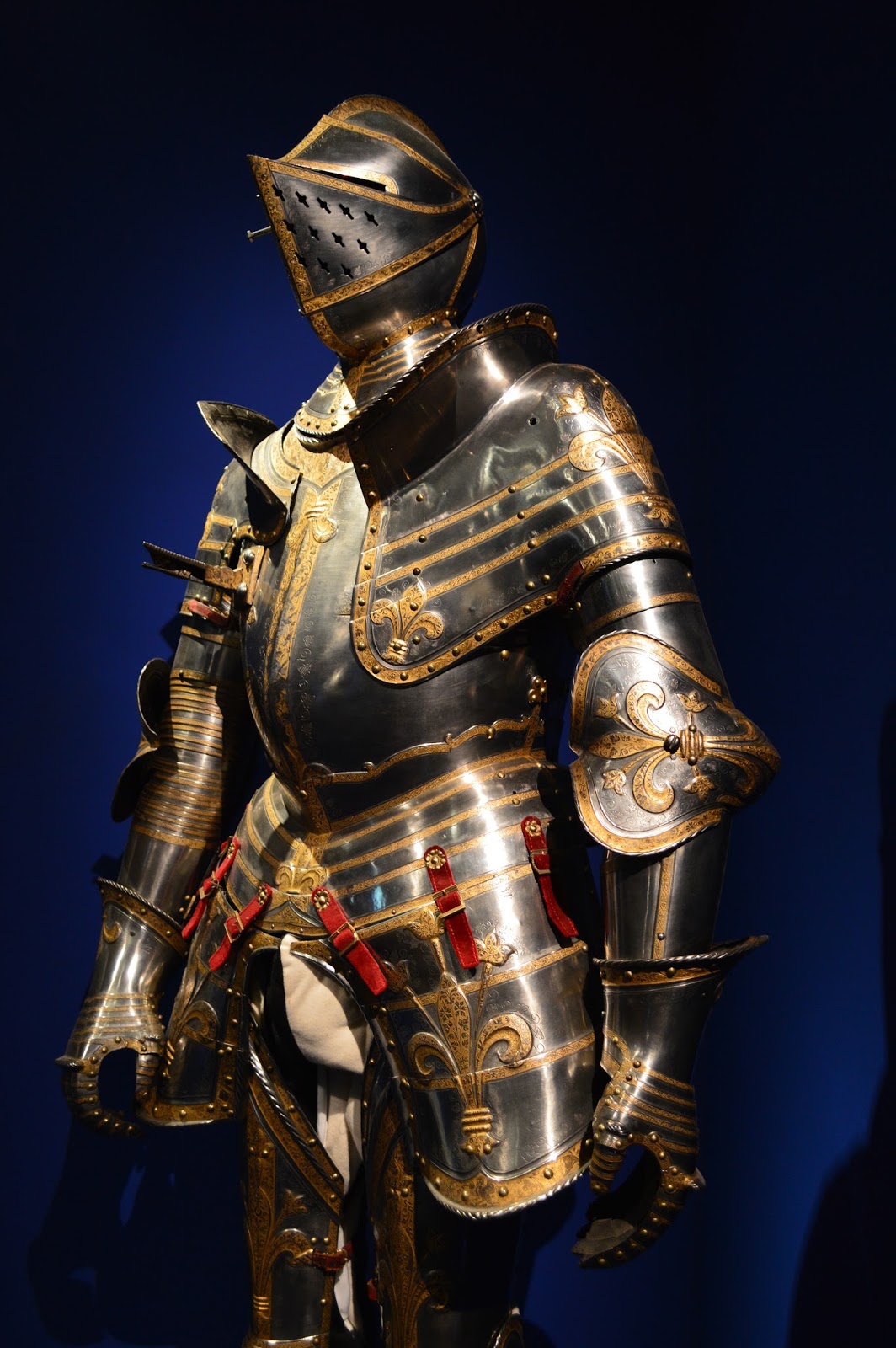
This temporary exhibition also features the Hundred Years war and the Italian campaigns of the kings of France including campaigns where Cesare Borgia fought on the side of the French against certain brutal Italian state rulers. Francis 1 features, of course. I got a closeup look at his suit of armour so intricately put together for him. There were excellent multimedia presentations on how a knight or ruler was dressed in his armour; the process and the equipment.

I didn't get to finish viewing the display as we were suddenly and hurriedly told to leave the building. An unattended suitcase had been seen in that wing and no doubt they were worried about terror attacks. It was really annoying to miss the rest of that exhibition though later I noticed people had been allowed back in. Too late for us to go back and see it before closing time.

The gold-domed chapel is where Napoleon's tomb is located. Well it's reputed to be him but who really says for sure. No one is prepared to do a DNA test and/or release the findings. He's enclosed within 5 separate coffins of various materials - rather like a pharoah. In fact this building consists of two churches and includes several sarcophagi.

 The two World Wars of the twentieth century featured information well-known but the artifacts and uniforms were still interesting. French colonisation made a hug impact and you can see the uniforms, and military hardware resulting from policies and struggles, especially in Algeria. It's pretty shameful but that's colonisation, isn't it.

You can't make a lightening visit to this museum. We underestimated it's scope and didn't really see everything available. There's a shop catering for all budgets with both tacky souvenirs and hand-crafted replicas. Many visitors were walking around wearing cardboard copies of Napoleon I's hat. Look for his imposing statue overlooking the honour courtyard filled with cannons from various battles. I couldn't resist taking a photo of his feet surrounded by cannonballs. 

The millions of men he killed as a result of his campaigns, ego and the rest. Sobering.

I hate war and killing machines but I still found the workmanship of the exhibits admirable, particularly the items from the middle ages and reformation. There are literally rooms and rooms of armour.

Open most days the museum features the following major sections:
Artillery in the cours d'honneur,
The dome church/ tomb of Napoleon I,
Antique arms and armour from the middle ages to 1643,
From Louis XIV to Napoleon III from 1643-1871,
The two World Wars from 1781-1945,
Charles de Gaulle Historical
Temporary exhibitions

Pay a little extra and get a Multimedia guide. It's much better than an audioguide. It's like a large smartphone or small tablet and gives you audio information of what you are looking at but also a visual commentary. This provides a rich experience, like having a personal historical guide; a great use of current technology. If you can't get hold of one at the usual entrance go to the other end of the site and ask at the shop. They tend to be more helpful.
www.musee-armee.fr

Friday, 1 January 2016

A meeting with The Little Prince

I travelled to Espace Richaud, at Versailles, to see an exhibition on one of the world's best-loved children's books. The Little Prince (Le Petit Prince) is a book for children written for grown-ups, written by author and aviator Antoine de Saint-Exupéry. It can be read on many different levels for readers of all ages and makes comment on the human spirit.

The exhibition centre, located on Boulevard de la Reine, was once an ancient hospital from the seventeenth century. It has been beautifully renovated, with most of the wings sold off as private apartments. Inside, the exhibition was tastefully presented on several levels with a small shop were one could buy memorabilia, mostly for children. I got a mug and a hardcopy edition of the book. Outside the venue you notice one of the utility boxes, scattered around central Versailles, tastefully portraying the fables of La Fontaine.

The book has become a global marketing phenomenon, with roadshows in other countries, films, records and CDs, comics. A shop dedicated to the book is now open in Paris 57 Boulevard Arago, 75013 Paris.  There's also an online store which will handle international sales. Go to http://www.thelittleprince.com  Comics have been created about the story and one touching one features the author talking to le Petit Prince as he, the author, dies in his plane wreck on the bottom of the Mediterranean.


The book's story goes like this..

The author, an aviator, crashes with his aeroplane in the middle of the Sahara desert. While he is trying to repair his aeroplane, a little boy appears and asks him to draw a sheep. The author learns that The Little Prince comes from asteroid B-612 where he has left behind three volcanoes and a rose.

Before reaching Earth, he has visited other planets and met some strange people: a king, a conceited man, a drunkard, a lamplighter, a geographer.  Since arriving on Earth, he has spoken to a fox who has taught him that to know someone or something, you must « tame » them, and that makes them unique. « What is essential is invisible to the eye, says the fox. »   You'll have to read the book if you want to know how it, rather sadly, ends.

I don't remember the first time I met The Little Prince but it was decades ago, maybe at Teachers College where I was studying children's literature. This book is so famous it has been translated into more than two hundred languages.

 Its author disappeared - shot down by a German fighter pilot while on a reconnaissance mission in 1944  and mystery surrounded this for many years. In 1988, off the coast of Marseille, a fisherman picked up in his  nets an identity bracelet bearing Saint-Exupéry’s name. Then, early this century, the wreck of a P-38 Lightning was found in the Mediterranean. The serial number on the plane identified it as the one Saint-Exupéry was flying on his last mission.


Thursday, 24 December 2015

Leaving 2015 annus horribilis behind

It's almost Christmas Day and while my Christmas will be much the same as I've experienced for the last 5 years it comes in the wake of a difficult year; a year full of loss of things that were important to me, and still are.

It started with the loss of my home and belongings that I had tried to build up since arriving in France. Every year I have to find new employment because my contracts are ever only for a maximum of a year. They are not well paid because I have to fit in to an extremely limited  range of options possible for a foreigner like me. I discovered there was only one option this year and it was worse than any of the others I've had here.

With no assurance of being able to pay my bills I had to give up an independent life as an adult and live with JC within the confines of his systems, rules and environment. He has tried to accommodate some of my needs like giving me a vegetable garden to occupy me for 5 months of the year. He does many little things to please, he is a dear, but it remains difficult for me to truly settle as nothing is secure or even predictable past August 2016 at this point.

The instant I made the agonising decision to give up my independent life and environment (well, it wasn't really a choice) I felt serious pain in my neck. Life had become a metaphysical pain in the neck for me. There are structural/aging reasons for this pain which Xrays and MRIs confirm but I do believe that major stress has been behind the physical pains from problems I've experienced in recent years. There is no medical treatment for neck conditions due to degeneration. One minute I was pain-free, the next I was not and haven't been for 5 months, despite physio. I need to change my circumstances but there are no current viable opportunities to do so.

As a consequence of the debilitating neck pain I've had to give up playing the violin. I'd spent a year working hard to get back some of the skills and joy I'd had in my youth so I grieved. It had been a bright spot for me, physically entering into the music with my teacher and connecting with the instrument I acquired when I was 11.

I'd booked a trip back to NZ for the end of February for my daughter's wedding. I planned to spend time with her, meet her husband-to-be and travel down to Christchurch to see my mother who is 86 and suffering dementia in a rest home. My daughter had to cancel her wedding so I had to cancel my trip. I still have her wedding present, just in case. Getting back for a visit is difficult as I can't take time off during a NZ summer. I'm limited to the middle of a NZ winter. I grieved for that little ray of excitement extinguished.

Other negative things occurred, so I guess if the Queen can have an annus horribilis so can I.

I'm always looking at ways to minimise negative things and move forward even if the likelihood of success isn't great. I'm not one to give up, and anyway what's that? Giving up just puts you in a worse situation you can only blame yourself for so I counted the days until I could apply for French naturalisation. What will that give me? Well, the right to stay here in France. That means a choice even if I may lack the means to stay in years to come, less bureaucratic obstacles to employment even if the French think I'm too old to be employed. And tucked away, trying not to suffocate from all the problems is that soul-thing that brought me here in 2010. It's been months since I sent in my dossier but no word of an interview. That might be normal.

I look at all the happy posts from friends on Facebook and it gives the impression everyone is having fun times with holidays, colleagues, friends and family. And then I remind myself that not everyone is in those sorts of circumstances. JC does his best in the situation dictated to me and I appreciate the little things he does but I really need my situation to positively change. I just can't seem to change myself any more. All I have left for 2016 is hope. Maybe that'll be enough.

To everyone having a less than terrific time - Merry Christmas and hopes for a brighter New Year. Please take care of yourselves and those you love.

Tuesday, 24 November 2015

Coping with terror

As a university teacher I'm confronted with the after-effects of terror attacks in France. On Monday last week my classes were filled with zombies: unresponsive students with blank faces and no interest in anything. They had no interest in working, participating, discussing, thinking. It then didn't help that at midday our oral assessments were interrupted by a direction to go downstairs for a minute's silence for the victims of the Paris attacks. It was a case of persisting with basic classroom control and hoping that somehow classes would move beyond babysitting.

There was a noticeable psychological effect on students and as a teacher I needed to deal with this throughout the week. Sometimes it was necessary for me to acknowledge that they were behaving like zombies, tired and maybe a bit down. Sometimes it helped to initiate things by building a list of vocabulary around terrorism on the board so they could write about it. Sometimes classes needed a pep talk about how it's normal to feel tired and joyless in these situations but that life is often shit and always changing so there's a possibility that tomorrow will be better...so let's do our best and get on with it all.

My students range in age from 18-24 and it's the younger ones who seemed to find it hardest. Some of them may have known someone directly affected. Even Jean-Claude's son had two friends injured and a third was killed in the Bataclan massacre.

Last week the army were very present, momentarily. They were present on Tuesday at the Versailles train station but my students later explained they'd have been there for the assembly of elected members who were voting on whether the state of emergency would be extended to 3 months (it was). Odd really. The terrorists aren't bothering with politicians, they are killing ordinary people but it's the politicians who get the best and most expensive security.

Security guards or fire-safety staff are everywhere though. I'm constantly having to show my ID card and open my suitcase at every door on either campus. We've had 3 building evacuations in one and a half weeks (usually during important tests) and it's not funny since the buildings are normally so closed off we'd normally never get out during a really serious event. The supermarket in Saint-Quentin-en-Yvelines insisted we all open our jackets before we were allowed in; paranoid for explosive vests no doubt but a determined terrorist would always get through - maybe explode while we were all queuing up to show our coats?

Life has changed much more than it did after Charlie Hebdo. I myself am a burnt-out zombie; smothered by the 24/7 media reports and online forums. I'd already lost my joy for life and this isn't helping me to feel I have any modicum of control in my life.

This week the only sign of the army I saw was an empty army truck at the Versailles train station and one solo soldier with his automatic weapon. I know they have to be seen to be doing something but as the Prime Minister Manuel Valls pointed out months ago - we just have to learn to live with this. And frankly, the security presence is only symbolic. France is too bankrupt to do anything more.

When I was much younger it was the threat of nuclear war that had us nervous (and we still have reason to be). Yes, we have to adapt, sacrifice, let go of how we used to live. It's tiring and it doesn't come easily. It leaves negative traces in our subconscious, even those of us who live a few kilometers away from the Ile de France region. I often wonder what is happening to all the wounded still in hospital and feel grateful it's no-one I know. Poor Paris and poor all the other places that have suffered from these cretins. We need to wipe them out.

Photo taken from the internet

Saturday, 24 October 2015

How to become French - Part 1


Last Sunday I spent 5 hours completing my application to become a French citizen and it was in the post on Monday. This whole process is extremely time-consuming, expensive and stressful but if I want to have dual nationality I have to see it through to the end. It's time-consuming because everything has to be copied, much has to be done by hand, often you must visit somewhere and stand in line for an interview in order to obtain official documents. Often you don't know who to approach even at your own place of work.

It's expensive because many of the documents from New Zealand must be paid for and so must the official seals (apostilles) to say these are indeed official and original documents. Once you have all NZ documents you then have to get them all translated by an officially approved translator. Even the postage back and forth between ends of the planet can get expensive.

And lastly it's stressful because there is a time limit to it all. The documents must be less than 3 months old even if nothing has changed in decades. The postal service between France and NZ is slow. You have to allow 10 days each way. Documents I sent to NZ spent almost a week in France before jetting off to Wellington or Christchurch. Some documents coming from NZ took at least 2 weeks to arrive in France because they were sent via Australia, then Bangkok, then Hong Kong, then Germany etc.

Full marks to NZ Births Deaths and Marriages for their efficiency in getting things produced and sent directly to the Apostille service. I had to deal with both Internal Affairs and the Ministry of Justice.
BDM were on the ball and got things done and back to me in just a couple of weeks. Not so for my conviction history. They say it takes 20 working days after they receive the official request. Actually they have a backlog so it takes longer. When I heard nothing and my nails were bitten down to the quick I phoned and the nice man discovered that what they were sending me was incorrect so legally useless. They'd spelt my name wrong. Back to the drawing board. The correction seemed to take a lifetime to arrive.

The only hiccup with BDM was that they charged me twice. It took a bit of phoning and sorting and waiting to get reimbursed but... we got there. BDM charges and so you get efficient service. The Ministry of Justice doesn't charge and it takes forever. I had to contact the district courts where my divorces had been concluded and ask them to send me copies. They are photocopies with holes punched in them but have an official stamp saying they are legal copies. I still had to get apostilles and translations done though. Terribly important documents were trudging back and forth across the planet while time was ticking away. Remember, all documents must be less than 3 months old when they arrive at the prefecture.

In my case I had to send my dossier to the Prefecture d'Indre-et-Loire in Tours. It was sent registered, of course, and things now become nail-biting as I wait to see if the civil servants consider I have an acceptable and complete application. If I pass that stage I will wait for an interview. This whole process can take up to two years of waiting and worrying. If my dossier is found incomplete or unacceptable I will have to start the whole thing over again.

Here's a list of what I had to supply in folder number 1.
1. Cover letter handwritten explaining why I want to become a French citizen
2.  TWO copies of the official form CERFA asking for naturalisation
Civil state
3. My birth certificate (an original + apostille +translation)
4. My two marriage certificates (originals + apostilles + translations)
5. My two divorce papers (official copies + apostilles + translations)
6. My parents birth certificates (official copies + apostilles + translations) and I also included my parents marriage certificate just in case
Professional situation and financial resources
7. Copy of my current job contract showing date of hiring, salary, activity
8. Copies of the last 3 pay slips
9. The payslips for last 3 Decembers (I added these in as some prefectures ask for this)
10. Attestation/proof form human resources I've been working at my employment for the past 5 years
My tax situation
11. Complete copies of my last 3 years' tax returns
12. Official form P237 showing I have paid all taxes, including income and local government rates

13. Criminal conviction record from NZ (original + apostille + translation)
Proof of address
14. A letter from Jean-Claude stating I live with him
15. A copy of JC's national identity card
16. A water bill from JC proving his address
Language competency
17. Proof of my competence in French from official tests - level B2 (I only needed a B1)
Additional documents
18. 3 identity photos
19. A copy of both sides of my titre de sejour (residents card)
20. Two standard envelopes, stamped (I also supplied my address stickers )
21. A letter of support from the president of the heritage association in my area (I'm a member and translate brochures for them) optional
22. Copy of my passport

Folder 2 consisted of copies I had to send. I also supplied a list of all documents included in each folder in the order given, to make it easier for the civil servants to find everything.
Later I must pay 55€ in tax stamps. The CERFA forms want all your employment history and all the places you have ever lived. Well, I don't remember the addresses and exact dates of the first 20 years and have no documents to help me. Much of that old stuff I threw out before I left NZ as I only had a suitcase with a 20kg limit at the time. I never imagined I'd need that. I've done my best and so must hope for the best.

I'm applying for naturalisation on my own merit.  I'm not marrying anyone to make it easier as no one is seriously offering that. I could have shaved 3 years off the 5 years needed before applying if I could have done a post-grad degree here but without someone to financially support me that was impossible though I would have liked to do it, despite my age. My European ancestors go too far back to be of any use - it has to be your parents and even then you have to live in France 5 years before applying. So, France either sees value in me or it doesn't. To date it has been totally indifferent or rather discouraging but I'll see this through to the end... whatever that is, I know I've tried.