It's downright cruel. Here I am in France, known for its culinary delights, in the centre of a Europe known for its sweet morsels, but I can't, in all discipline, indulge. A whiff of sticky sweetness, the merest lap of tongue against lolly, even the cracking sound of a slab of chocolate being divided is enough to put half a kilo on my scales. It's the unjust burden of middle age. I rail against it but it does no good. And then JC insists on visiting the Salon du chocolat at Chartres.
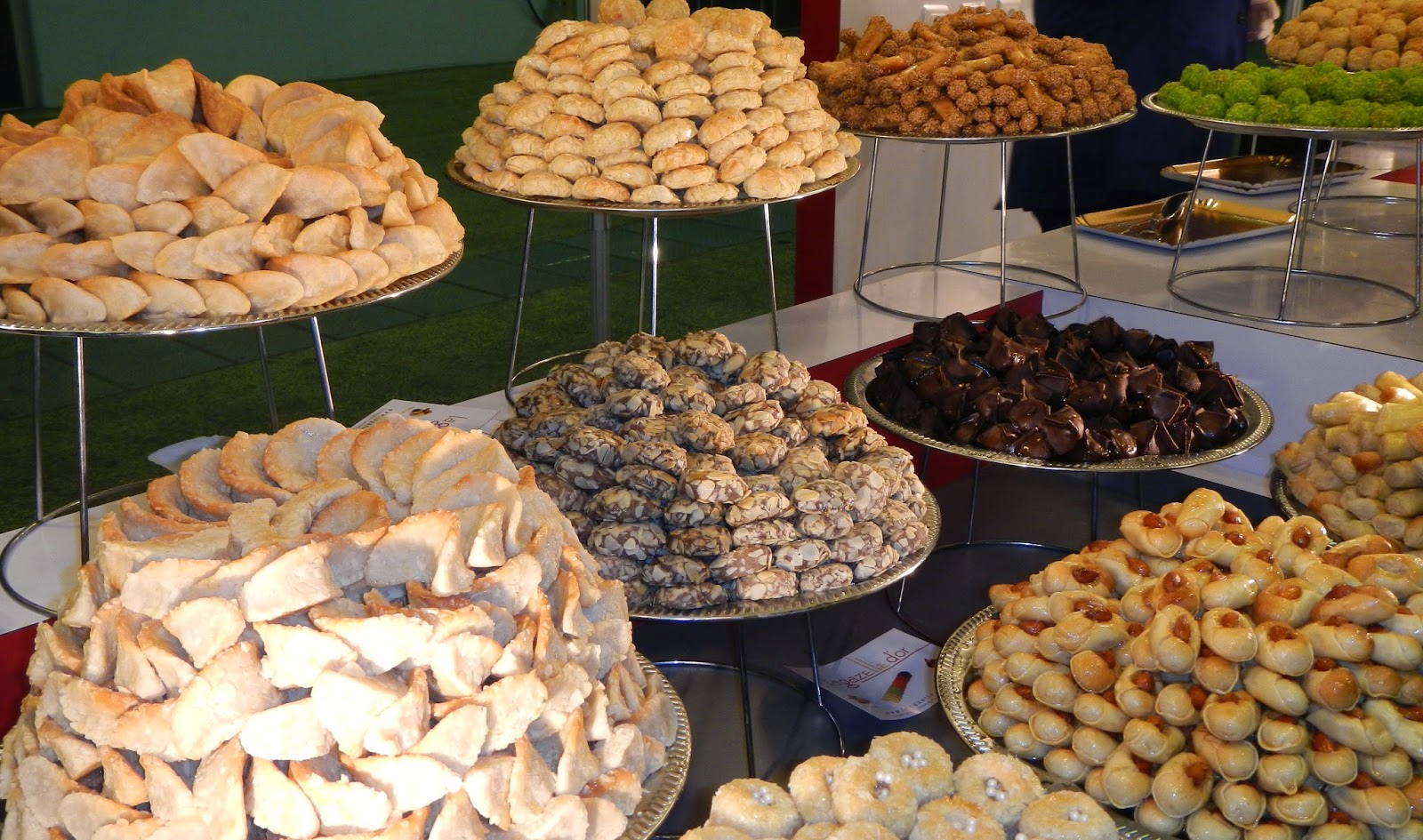
There you will see sights unknown in New Zealand. How would you feel about a block of nougat the size of a small dog kennel?
Or rows and rows of sherbets, suckers, and dainty sweet pastry thingees. Oh the chocolate section. For goodness sake - who actually eats all this stuff? It can't be the French women with their pipe-cleaner thighs.
Every flavour imaginable was there, and then others unimaginable. The disappointment for me was the dried kwifruit slices - tasteless and pointless. There was quite a bit of maroccan fare there, presented on plates. All of which was completely new to me. Beautiful presentation though. The French excel at this sort of thing.
The only thing we came away with were some tourteaux from the Poitou-Charente region. They are of a savoury dough nature inside with a burnt top, a nugget of cheese inside at the base. They look like canonballs. We bought some for the sentiment - my French ancestors having come from that region.
We didn't eat or buy any chocolate, incredible though it seems. When you're surrounded by a surfeit of delectable delights like this you can feel so overwhelmed there's just nowhere to start. So... enjoy the torture of these photos from your armchairs. PS. There were other foods such as dried meats and cheeses, cheeses, cheeses on offer too.
I could only be talking about Hemp, of course. In various places around the world this very useful plant has been cultivated and industries created, mostly in the past, though it still continues on a small scale, including in NZ and France.
It's leaves are almost identical to the sort smoked by drug addicts or cancer patients but it has a low quantity of the active narcotic substance. Hemp is refined into products such as hemp seed foods, hemp oil, wax, resin, rope, cloth, pulp, paper, and fuel. These products are still available and some people like hemp clothing, though it's usually mixed with silk or other fibres to reduced the coarseness. The fibres were wound on bobbins and could be spun or woven on looms.
Hemp rope was used on sailing ships though the rope had to be protected by tarring, since hemp rope has a habit of breaking from rot, as the the rope-woven fibers tended to hold liquid in the interior, while seemingly dry from the outside.Tarring was a laborious process, and earned English sailors the nickname Jack Tar.
Hemp fell out of favour as new technologies provided better ropes, oils, clothing and paper.
The whole plant can be used for various products. Nothing was wasted - a truly eco plant.
Hemp plants grow rapidly and this has several benefits. Its height, dense foliage and its high planting density
as a crop, is a very effectivemethod of killing tough
weeds in farming by minimizing the pool of weed seeds of the soil. Using hemp this way can help farmers avoid the use of herbicides, to help gain organic certification.
Hemp is usually planted between March and May in the northern
hemisphere, between September and November in the southern hemisphere.It matures in about three to four months.
It is illegal to grow this plant in the United States; they are nervous it's similar to its druggie cousin but it wasn't always like that.
George Washington pushed for the growth of Hemp and even grew hemp
himself. In May 1765 he made notes in his diary about the sowing of seeds
each day until mid-April. Then he recorded the harvest . Thomas Jefferson, also a hemp
farmer, developed a better way to break the stalk by modifying a
thresher and would also share the flowers of the plant for smoking. Washington and Jefferson
both preferred this to drinking alcohol or using tobacco, which they
both saw as health concerns for the US.
The seeds are well liked by birds, having a high oil content. I wonder what the chickens' eggs were like after the hens gorged on these seeds.
In NZ we're having problems with synthetic cannabis destroying lives. At least this species of plant is relatively harmless and useful.
There's no doubt France is rich in heritage, monuments, history. Tourists and locals have many opportunities to see chateaux restored and now tourist attractions but there's another side to restoring and preserving heritage buildings. I saw the other side last weekend.
L'Association d'Epernon patrimoine et Alentours hired a bus to take us on a day trip into the Sarthe region. During the afternoon, we visited the Manoir de Verdigne. It's a manor house and collection of buildings which used to be in a quadrangle formation, dating from around 1580. It was a fortified residence as there were many wars going on at this time.
The buildings are in a dreadful state of decay and the amount of money being spent on restoring them is gob-smacking. Some money comes from the State, some from a foundation and the rest from two agricultural owners. Where they get the money to restore on this scale is beyond me.
I was shocked at the state of decay that had occurred over the centuries. I love to see history alive. This was just plain sad. It's also sad to realise the megabucks spent will never restore it to what it was, the buildings will never be habitable (if they were the taxes would be horrendous). The owners have no heirs and they are not young; clearly it's a labour of love.
They've done repairs to some of the outbuildings. Currently there is a large gallery with its roof removed which will have to be completely redone. It's covered in scaffolding.
The ceiling beams on the upper level of the main house have been replaced. I think it has cost 50,000 euros just to do that. Each window in the main house may cost as much as 15,000 euros. Extraordinary.
This is a manor house as you would normally never see it. This is what they look like if neglected, ransacked, modernised. It's very difficult to know what it's original state was like, there are few records surviving.
It's thought that originally there may have been a tableau above the downstairs fireplace. A narrow staircase has been recreated at a cost of 20,000 euros but it's hard to see where the money goes. It's hard to see how this is all going to end well. I hope it does but is this love or folly.
One of the out-buildings bordering on the stream used to be a stables. You can see where the feed for the horses was kept and the long water trough. However, before it was a stables it was a residence. Faint traces of painted decorations can just be made out on the beams, tulip designs among others. We wondered how the owner will generate any tourist interest in the property once it is completed as it's very out of the way, near Mamers.
I caught the train to Paris. This isn't something I do often, because it can get expensive, but I had a job interview with a language school.
I'm needing to look for work because the university is cutting staff. I really hope they renew my contract for the second year but it's all looking a bit dicey.
The language teaching industry is known to me, I went down this track back in 2010 when I was trying to get into France through that route, and failed. I know I'm the perfect sort of candidate, with my qualifications and business experience across multiple industries. This was confirmed in the interview. Another thing that was confirmed is the extremely low remuneration and lack of provision for preparation time and travelling between client companies. That's at the employees' own expense. There is no permanent contract with these companies and they don't guarantee hours. Employees are only paid for contact hours so if there are not many clients or it happens to be during the very long French summer, well, there might be little or no pay for months. Despite all this there seems to be no shortage of teachers queuing for an appointment. I won't know if my contract will be renewed for the final year until June and the interviewer said she wouldn't know if there'll be work for me until June so, we'll have to wait and see.
One of my students stayed behind after class today for a chat and to give me some feedback. We chatted for a good 15 minutes and it was great. She told me she was so happy that she'd had me as her teacher and not to lose my enthusiasm as it's just right. She told me not to get disheartened by the lack of participation from the students; they don't know any better and it's not against me personally;in fact the students all like their class. They are normally not given the opportunities to really get to know their teachers as human beings, as school classes are formal and there's always a firm line between teachers and students. She agreed that many students shouldn't be at the university but that's the system, they don't know what else to do. French people don't make changes in their lives so much as anglo-saxons, when life's circumstances change, so there's no such thing as going back to uni and changing career. They need to know that's Ok, she said.
The student admitted her eyes were opened by the fact she'd attended school for 10 months in the US and came back totally excited and stimulated, only to later find herself slipping back into the old sad, French ways.
France is too complicated, it won't move with the times and has hung systems millstones around its neck so it can't move. It does worry me, when I see the state of things, the state of conditions at French universities, the waste of human potential because French teachers don't encourage personal development. Such a shame, I'd love to help, but I'm banned from teaching English in schools because I'm not French, and haven't sat a competitive exam in French, of all things.
We enjoyed talking to each other, my student and I, and I loved watching her blossom and open up in confident English. You'd never realise she was so competent by watching the class. I'm sure she will do very well in the future, and I've promised to help her with things she'd like to learn on our last lesson. I do hope it's not the absolute last lesson I ever teach in my life.
After leaving the interview I decided to walk from l'Etoile to Chatelet via the banks of the Seine. I wanted to see Paris getting dressed up by Spring. It was a bit of a walk with all my bags, heavy coat and business attire but it gave me an opportunity to take pictures. I felt so at ease here, it's still a place of tranquility for my soul - if only someone would give me a job in this city of millions.
I walked past the Musee d'Orsay and saw Thomas Jefferson sunning himself on the quai. On past the Louvre, the Pont des Arts with all the padlocks. Not too many tourists yet, just double-decker green tourist buses doing sightseeing. It's all rather normal for me now, part of my backyard, in fact, but I always appreciate the fact I'm actually here.
Sometimes even Paris can be mediocre - I ordered a hot chocolate at Gare Montparnasse and an overpriced thing made from powder arrived. Charming waitress, but after paying 4.70 euros for that I didn't bother with anything else.
After all the trains and metros I'd negotiated for my visit I was keen to catch my train direct to Epernon, chilling out listening to music as the countryside swept by. Gotta love France.
Last weekend I went along to the Paris Book Fair. I thought it might be somewhat of an education for me, as I'm self-publishing a book on moving to France. I imagined I might learn something. This was a delusion. I also thought it might be a good opportunity to network, make some contacts, hand out some business cards I'd made specifically for my book, for this fair. Wrong again.
Having read as much as I could on the event website, in English and in French, I had erroneously assumed it might be a bit more international than it is. It's strictly for francophones, French authors and French publishing houses. Almost no one spoke English. Various regions of France were represented, as were French overseas territories, and a few other countries such as the guest country for this year, Argentina. The only international publishing flavour present was a small exhibition area by Amazon - a smart move on their part. Their display space concentrated on their print-on-demand division CreateSpace and their ebook division Kindle Direct Publishing, plus e-reader devices such as the Kindle Paperwhite and Kindle Fire HD tablet.
Publishing must be booming for Amazon, as for 98% of writers, finding an agent and publisher is an impossibility now. Agents and publishers are mostly only interested in what they consider a sure-fire hit by a known writer or celebrity, or something that's the latest fad. Good writing has nothing to do with it; much as good screenplays and films have nothing to do with Hollywood backing. Amazon is filling the market void, enabling indie writers, like myself, to avoid the rip-off publishers known as vanity publishers.
With CreateSpace I can publish my book and take a much higher percentage of royalties while retaining all my rights to my own material. I have to do all my own marketing but that would still be mostly the case if I had a traditional publisher doing the rest for me.
I've paid to have my manuscript professionally edited. I've paid to have my book cover professionally designed so that I have total control over how things look. It's not cheap, but it's cheaper than vanity publishers, without all the disadvantages of those. Everything else I must do myself, such as formatting interior design, uploading, tax issues etc. It's a learning curve where I take all the risks and most of the benefits, IF I can sell copies.
It's the same with KDP. I have total control over my ebook version. In order to reach readers using different e-readers not compatible with Kindle, I'll also publish on Smashwords. Each option gives me international coverage. So, apart from a couple of tips gleaned from a speaker at the Amazon stand, I learnt nothing. I spoke to one other print-on-demand business but he was small, gave tiny royalities, locked in rights for two years and had limited knowledge of Amazon's business. I suggested he bone up on it, as he'd have a hard time competing. I've little time for businesses that don't see the need to understand their competitors. It was also a bit of a surprise seeing the obsessed fans of certain authors queuing forever to get a signed copy. These authors' names meant nothing to me because most were strictly French. Most of the congestion in the exhibition was due to these book groupies.
I don't have the means to visit the London Book Fair. Maybe if I can have modest success with my book Follow My Heart it might be worth me doing that next year.
It's always been a great sadness to me that I am not able to do real gardening here in France because all I have right now is an urban apartment. Sure, I have a balcony and I furnish it, stuffed to the gills, with flowers and vegetables in summer but it's so limiting. I need a parcel of land. The state of things at work being what they are, I don't know if I can keep my apartment much longer because it's unclear if my contract will be renewed for its second and final year.
I've just found out that my bankrupt employer will be cutting staff (teaching staff) by 20%. An administrator has told me I should look for something else now, in case of the worst. That's bad and I know who is to blame for this apalling state of affairs. I hope something extremely nasty happens to that person for hurting so many innocent people. But so far, all my efforts to find work, the hundreds of hours spent in applying for jobs, filling in online forms since November 2010, when I realised the awfulness of the job situation I found myself in, have resulted in a big fat zero. How can someone with all my various industries experience, education and application find herself effectively unemployable in both France and NZ? Clearly, whatever efforts I am making are not meant to bear fruit and there's no alternate path I can see, other than my writing and that's unlikely to provide a reasonable income one day. I need a miracle so I'm trying to remain hopeful while psyching myself up to lose everything I've tried to build up in France. It's getting harder and harder to deal with this while keeping a cheerful outlook.
JC knows what I'm trying to deal with and I think he has finally realised just how serious things could be for me. He's trying to help pick up my spirits and give me something to work towards. As I arrived at his house this weekend I just burst out laughing. He had made a sign; in his own way he was trying to show me I had a place a little closer in his life.
I also think it's pretty romantic in its way. Why? Because despite for years telling me he would never have a conventional garden (bare earth) and especially not a vegie garden (too much work and too risky if a fox pissed on the vegies) he has decided that one day after he has had the land tidied and levelled that I can have some of it for myself. I'd be able to choose all my favourite flowers and vegetables and even have raspberries and grow them. I could have a real garden at his place one day. And if I become unemployed I could live with him until I can find a solution to my residency issues, if I can find a salaried job somewhere.
He made sure I noticed the exact wording: It's Kiwi's Land (his nickname for me is Kiwi because I'm a NZer) and it's for me. "It's not Kiwiland" he said. I'm touched by this as he's such an independent person (I am too) but it's a very sweet gesture with a message that he sees me in his life in the future. I'm doing all I can not to wreck his independence or mine (at our age it's rather important to have this) so I continue with my frustrating job search in a country with rules that go against me.
We had a bit of fun with this as you can see; Baika the hunting dog guarding my 'territory' with me and JC's hunting rifle. We later added the barbed wire. So, no trespassers. This might be as close as I ever get to having a little bit of France on loan.
This week I had my Modern Literature students study a famous American poem. It has special significance for me these days and is about making choices in life; between two paths which seem a little similar but we choose one and hope to try the other another day, knowing that we are unlikely to. We choose a particular path and this makes a huge difference in our lives. Yet, we think about that Road not Taken so what is this difference between them, in the end? We don't know. I wonder how it came to be that I inadvertently chose this poem for my class. It was unknown to me a month ago.
Looking back I can see there have been instances of diverging roads and I've tended to take the one most travelled, a false 'safe' path, until 2010. Now, here I am. Recently I've taken another path through the wood, I'm trying to become a successful author and I'm taking the self-publishing route. It's a difficult path where most people sell only 100 copies. I want thousands of my books to sell (at least) and that's going to take help from friends and networks and a truckload of effort on my part.
What's down the path where I don't try to become an author? I assume it's more of the same right now and no hope of advancement, a slow decay fed by disappointment at a lack of options, so I'm giving myself an option. There are no guarantees but it's more open that what I see right now. I need income to survive into old age and I want to help others consider issues and 'feel' their own lives through my writing.
However, the Poem is called the Road Not Taken and so maybe we look back with 'what ifs?" Human nature tends to provide justification later for what decisions we make, especially if the choices are not really clear at the time. We put a positive spin on them.
Choices are frightening, risky things. Sometimes we feel like they aren't really options, just a sort of life or death decision. That's how it is for me these days. The things I decide now at this stage of my life feel as if they ring of 'life or death'. I'm living more on the edge than I have ever done but for me the option of sitting back and doing nothing to move the wheels of the universe is a slow death. I don't know where this path will lead but along the way I'll be writing books and doing things I haven't yet imagined, and living.
These issues of life choices rang a bell with some of my students as we got to grips with this poem. Some of them have some hard decisions to make themselves and for some of those it was emotional. Here's the poem for you to enjoy, as they did. The video's lovely too.
The Road Not Taken - Robert Frost 1874-1963
Two roads diverged in a yellow wood,
And sorry I could not travel both
And be one traveller, long I stood
And looked down one as far as I could
To where it bent in the undergrowth;
Then took the other, as just as fair
And having perhaps the better claim,
Because it was grassy and wanted wear;
Though as for that, the passing there
Had worn them really about the same,
And both that morning equally lay
In leaves no step had trodden black
Oh, I kept the first for another day!
Yet knowing how way leads on to way,
I doubted if I should ever come back.
I shall be telling this with a sigh
Somewhere ages and ages hence:
Two roads diverged in a wood and I --
I took the one less travelled by,
And that has made all the difference. http://www.youtube.com/watch?v=KUaQgRiJukA
My dream was to become a French citizen and live and work in France for the rest of my life. I am now a French citizen and member of the EU but circumstances made it impossible to stay so I'm back in New Zealand reinventing myself.