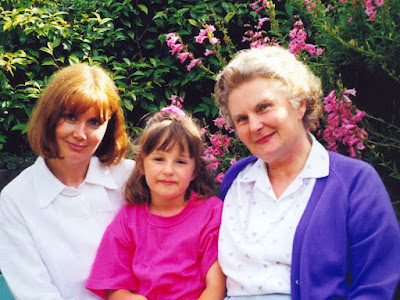
 Recently I've had cause to reflect on my relationship with my mother. It was never a loving one from her side but I had no idea how much she must have detested me and the malice and spite she wanted to inflict past the end of her days. I gave a very sanitised eulogy at her funeral but have since decided that some truths need to be shared in order to start a difficult healing process because I am not the only one out there struggling from a lifetime of family abuse (not just from my mother).
I write about events in my life and what matters to me and sometimes my posts are useful to others.
Not all mothers should be mothers and the lasting negative effect of them on some of their children should not be underestimated. I really don't know how to understand any of this and it's doing my mental health damage. I simply don't know WHY? It is worth noting that parental abuse doesn't necessarily stop when you leave home, it can last a child's lifetime, past the perpetrator's death.
Let's take a chronology of what I have lived through as examples of varying forms of abuse (and similar stuff will have happened to some of my readers)
 Karitane hospital
When I was born nursing staff were concerned about my safety with my mother. My father told me she was treating me like a doll, a thing to pick up and put down with no connection at all, with little interest in me. I was therefore transferred, with my mother, to Karitane Hospital in Christchurch where staff hoped my mother might start behaving like a mother. Luckily for me, less than a year later my parents moved in with my maternal grandparents so my mother's day-to-day responsiblilities could be handled by HER mother. There was no love though I was fed and clothed and looked after. Sadly my mother gave birth to my brother and he, being a male, was much preferred by both parents. He was often a bit sickly with skin troubles so got a lot more attention than I did, even when I got measles. By the time I was four my parents had saved up enough and got a government State Advances loan and capitalised the family benefit to start building their own house. Now I was on my own with them.
The beatings
These started around the age of 4-5. It could at times be my mother, but the older I got she started getting my father to beat me with his strong hands and belt buckles. He would do it for a 'quieter life'. One day, he went too far and left me black from the waist down and even my mother thought she had better take me to the doctor. She told the doctor I had fallen off the jungle gym at school. There was no way for me to contradict her to the doctor. It was super painful and difficult to sit at school or walk for a month. On another occasion I saw my mother trying to impale my father with the vacumn cleaner tube.
Sent to the police
When I was nine I was so terrified of my mother that I didn't dare to tell her I did not like peanut butter sandwiches in my school lunch so I hid them. Throwing them out at school would have been reported to my parents. The only place she rarely went was my bedroom wardrobe. I knew it was risky but didn't know what else to do. Of course she found them and went ballistic. She said I was an awful child and she didn't want me any more, maybe the police would find a place for someone as rotten as me. My father complied and drove me several kilometers to the Papanui Police station. I felt terrified because my home was the only one I had known and I knew bad kids had bad futures and dreadful things could happen to them. I wedged myself (in my pyjamas and hugging my toy kangaroo) in the doorway of Dad's car. It was difficult to pry me loose I was so desperate, so he gave up and drove me home and told me to apologise to my mother for being such a wicked child. There she was, enjoying a lovely hot bath, not a care in the world while I apologised to a woman I now despised. I knew a decent mother would never terrorise a child in that way. for any reason.
Absent when I left home
At the age of 18 my then boyfriend realised someone had to get me out of the family home. My father was now beginning to take a lascivious interest in me and my mother controlled every minute of my time at home. On the day I was to leave, my mother decided to go on a picnic with friends. She never said a word to me that day, not even goodbye. My father was absent too. I had very few belongings, I just got into my boyfriend's car and we drove away. At least I wasn't going to get hit again but I had no money, no job, no friends, just a boyfriend kind enough to pay rent for a little flat in Hereford street for me to be safe.
Too busy 'washing my hair'
Years went by and I lived in various cities, Christchurch, Wellington, Auckland. My parents had limited interest in me and had separated not long after I left home. I tried to keep some communication going but too often when I came down to Christchurch I would ring my mother to suggest I visit or even stay overnight with her but she rarely said yes, Usually she said it wasn't convenient as she would be busy washing her hair that day. It hurt!
The day my daughter died
 In 1989 I was due to give birth to my daughter Aimee. Things went very badly, staff at St George's Hospital made many mistakes, the obstetrician was complacent. My dear wee daughter died inside me many hours after a timely caesarian would have saved her. A mother having her third child attracted their attention, rather than my haemorhaging. When my baby's father contacted my maternal grandmother to tell her Aimee had died she told him "Knowing Frances I am not surprised!!"
Horrific thing to say. My mother and her parents never contacted me; they didn't telephone me or send a card. They did not visit me in hospital nor come to the funeral. Years later, at each of my grandparent's funerals where, again, I came down from Auckland, neither my mother nor my brother could be bothered saying hello or letting me sit with them. I don't know why. I was left at the church while they took off for the interments.
Abandoned at French Fest
In 2006 my daughter and I went down to Akaroa all the way from Auckland to participate in FrenchFest celebrating the French landing there in 1840. My mother was there. I saw her and she looked at me and turned away quite deliberately to get lost in the crowd on the beach. I searched for her but never found her the entire weekend. She had been on our French family committee. Members of the Libeau family to which I belong were very surprised to discover I existed. "We knew about the son but had no idea there was a daughter". It was humiliating and sad that she did not want to see me nor her only grandchild. I had spoken to her by phone a couple of days earlier to let her know we would be down.
After the earthquakes hit
In 2011, while I was trying to build a new life from nothing in France, the second of some brutal earthquakes destroyed most of my birth city, Christchurch, NZ. 185 people died. I never heard from my brother or mother though they had my contact details. In desperation to find them I asked a former boss for help. He contacted the police who informed him my mother was alive but wouldn't give any more details. Without landlines these days it is difficult to find mobile phone numbers. Eventually I found an old number for my brother and called it. He replied but was completely nonchalant and didn't seem to care I had been worried for FOUR months. He had put my mother in a home as she wasn't safe to leave in her own home with her developing dementia.
As time went by there was never any reply to letters or phone calls or presents that I sent to my mother. I felt completely cut off, isolated and unwanted. I sent her books (one I published myself) and gifts from France. and I continued to call her regularly from France.
In 2016 my brother contacted me to say my mother had had a major stroke. She ended up going into a nursing home Between the stroke that robbed her of movement and speech and the dementia which made her forget things minute by minute it was hard going but I persisted in trying to communicate. She lived another 8 years like that. Long enough for me to be able to visit her regularly from 2017 when NZ retirement rules forced me back to NZ.

The will.
My mother died 5 days before her 95th birthday and I thought that at least now I might be able to put my history with her at rest but that was not to be. Whatever my mother's reasons for persistent cruelty towards her eldest child in preference for her youngest and male child I would never know but my mother had one more hand to play that affects me financially for the rest of my life.
She willed all her personal effects to my brother (he was her executor) and to top it off gave him a considerable sum of money for 'services rendered'? He was willed 90%. Just 10% for me, nothing for my daughter Laura, her only grandchild, and the will had been written two weeks before the earthquakes so I have no idea what was going through the minds of my mother and brother in 2011. Legal notes were destroyed in the earthquakes. The will was designed in such a way that it could not reasonably be contested. It was cruel and premeditated and the last straw for me, emotionally. My brother lacks any empathy on the issue. Well, he is now very comfortably off. I am scarcely able to pay my bills on the mediocre pension. It is not something I could forget nor understand - the vindictiveness and hate that must have resided for almost 70 years in her, against me my whole life. I suppose it is not something that can be understood.

My mother told me I would never amount to anything. That if I got pregnant I would be out on the street permanently. She taught me to always be afraid of everything because nowhere was safe. I still suffer from this belief today. She showed me I would never be good enough for her. I had no role model of how to be a good mother but I knew exactly how I did NOT want to be - like her. And so, what could I do after a lifetime of violence, manipulation, hate?
 The bonfire
I decided that since I have never been able
to talk to her about shared experiences in the past, nor ask her why
she has deliberately abused me in multiple ways I had to eliminate as much
of her negative energy in my life as possible. I've burned a lot of
documents. I have given away a lot of photos to sympathetic members of
the family.
There were hundreds of photos that remained of my mother and
her parents. I recently was told by a family member that my mother's father
(my grandfather) deliberately disinherited me. Just me and not the other grandchildren. I
don't know why, but learning that was cruel. The content, not the
messenger.
Therefore my daughter Laura and I held a private bonfire to eliminate the physical reminders of Mum and her parents from my life. Eliminating the emotional bits might not be possible.
I
burnt those hundreds of photos and old photo albums with NO regrets.
There are still enough images digitised on my computer to satisfy any
future needs to relook at certain aspects of my past. I never had a
mother, just a bitter woman who deliberately abused me emotionally,
physically and finally financially.
I hope such a spiritual and symbolic
cleansing might enable me to move on with my life, forgetting as much of
the past as I can and building a new future. I probably need therapy
but I can't afford it so the bonfire had to suffice. I want to create a
new life with few reminders of the past.
Photos: Me, Laura and
Mum, Mum and Me, Aimee's funeral, Mum, Laura and Me, Mum and me a month
before she died (she still doesn't look pleased to see me) . Bonfire
photos,
Self-Care Tips on Overcoming Abuse-Related Trauma
- Recognize the Effects of Trauma. Many effects of trauma stem from abuse. ...
- Understand the Importance of Healing. It's important to know that healing is key to overcoming trauma. ...
- Embrace Positive Affirmations. ...
- Exercise. ...
- Embrace Creativity. ...
- Don't Be Afraid to Seek Help from a therapist - very important
Signs of unhealed
childhood trauma may include anxiety, depression, difficulty forming
relationships, emotional dysregulation, low self-esteem, intrusive
memories, trust issues, self-destructive behavior, chronic stress,
substance abuse, dissociation, sleep disturbances, somatic symptoms,
difficulty with boundaries, hypervigilance. Check out these useful links below.
https://www.brooklyn.edu/dosa/health-and-wellness/personal-counseling/loss/child-abuse/
https://www.calm.com/blog/childhood-trauma-in-adults
https://counselingcentergroup.com/signs-of-childhood-trauma-in-adulthood/

 Béville-le-Comte is a small village in the middle of La Beauce, a wheat-growing region of France located around the cathedral city of Chartres. This area is mostly flat for growing cereals, and stretches for many kilometres. So as soon as I was told this was the capital of the world for scarecrows I immediately looked at the fields expecting to see some. There were none. Not a one. Not even the black kites shaped liked crow that move in the wind. How disappointing! Even the village website does not explain how they could designate themselves as the scarecrow capital if I couldn't see them.
 The town hall was constructed in 1889 to celebrate one hundred years after the Revolution (though let's keep in mind there have been several revolutions since 1789).
 Driving to and from this village has been a hairy experience because the roads are sometimes only wide enough for one vehicle. If vehicles need to pass they are both obliged to drive in their respective ditches and some drivers like to play 'chicken' to see who will move to the ditch first. Well, I'm not arguing with them, they win!


 Posts
Posts


