
On a fresh but sunny Thursday JC drove me the two hours to Tours for a date with destiny (one way or the other).
I had an interview, at the prefecture, for naturalisation to become a citizen of France (and Europe).
I'd been preparing for this for weeks and was feeling very stressed. Days and nights had been spent swotting the
Livret du Citroyen contents. JC had tested me on possible questions but I couldn't seem to make the dates and foreign names stick in my head. I knew much more than what was in the book but it wasn't me in charge of the questions and, in fact, any random question could be asked.
I'd trawled the internet forums for what I might expect. Some said it was pretty easy and the interview lasted only 10 minutes (really?). Others were served balls from left field by being asked to write letters in French or list a lot of ex-colonies, sporting heros, singers etc. In this case you can never really be prepared.
Still, I could prove my love and participation in France and things French. I took along a copy of my book,
Follow my Heart: Risking it all for a life in France. I also brought along a book on French history, in French and with a message from a friend saying it was a present in recognition of my love of France. The rest of my very heavy bag was full of books I've created over 5 years showing French culture, history, my family ties to France, and 4 books relating to my relationship with JC. The latter were never used in the interview. And I knew how I felt about things. I also switched on my Toastmasters training and Communications training because this so-important interview was in French and my competence was being yet again assessed, in a live situation rather than a 'test'.
I didn't sleep well the night before. My nerves were at such a pitch that when I arrived at Tours and got out of the car I discovered I was wearing two different pairs of boots. One for each foot.
Quelle horreur! No wonder I was walking with a funny gait. One boot had a heel higher than the other. At least the boots were on the correct feet and were both black. Mortified, there was nothing I could do about it.
Official documents I had to bring included:
- The latest list from the trésorie of my tax payments (the previous one with my demand for naturalisation was now no longer current)
- My current carte de Sejour
- My interview confirmation
- My work contract
- The last three payslips from my job.
The lady was pleasant and meticulous. There was to be no informal 10 minute chat with me. She took the entire hour covering many different areas of my life and activities. Some questions were unexpected, such as what period of history did I consider most important and why did it interest me? I plumped for the Renaissance and a little earlier. This being Tours, the chateaux of the Loire were mostly built during the Renaissance. She asked me to name them and talk about them. Sure I know heaps but under pressure, in French, one wonders just what one can say in a short time to convince someone I know stuff. Luckily I keep myself up to date on many things, such as the fact that much of Azay-le-Rideau is under scaffolding right now due to important renovations and that the hunting dogs of Cheverny are a special feature of a visit there.... And in fact there's a nice chateau near me called the Chateau de Maintenon (owned by Louis XIV's second wife) which I have visited many times.
She asked me what level of French I had arrived with. I told her I'd studied it in High School such a long time ago so although I understood the grammar I was very weak in anything oral, but one must make an effort to improve because the language and the culture are entwined. You cannot have one without the other.
She spent some time looking at my two passports, the current one and especially the cancelled one. In France you don't get to keep your old passport. I brought the cancelled one along because it has my visa in it and also the sticker from the immigration department.

Of course, the predictable question of why I wanted to become French arrived. It's not that easy to explain the intangible but I did my best and showed her how I tried to live my dream. I also explained that I was currently very limited by what sort of work I was allowed do on my visa. I'd like more options to use more of my talents. I'd made a commitment to France - I'd like France to make one to me. She asked if I had already decided to ask for naturalisation when I arrived in France. I replied no. To begin it was simply to realise my dream and have an adventure but that quite soon it became essential for me ; mind, body, soul to become French, officially, because in my heart and soul I already felt French, well, look at my name and my ancesters. My middle name Suzette is totally French.
Explain the rights and responsibilities of a French citizen. I barely got started on that.
Discuss the concept of
égalité. I thought that might be a good moment to mention that NZ was the first country to give women the right to vote. She asked me how I'd feel about having a female president. I said I wouldn't comment on Marine le Pen but females in such roles seemed completely normal to me. Life in NZ is democratic.
I had an active associative life? I explained I was a member and the translator for the Association d'Epernon Patrimone et Alentours. Being a member of community associations or groups is key in an interview such as this. I had also attended several meetings of the Business Women's Network at Chartres, including the recent visit by the international president.
I must have a lot of friends? Not a lot but the ones I have are all my age, except for the lady who had signed the present to me. I explained my job is very solitary and I wished I had more colleague contact.

And then one of the critical interview questions... How many times had I been back to NZ?
Never! She seemed taken-a-back. Never? Not ever, I said. I've brought my daughter here to see France a couple of times but she has her own life in Auckland and is getting married, and my mother has dementia so any conversation with her is difficult.
I didn't mention a planned trip had been cancelled. I didn't mention I had no money for regular trips, and anyway I don't miss NZ as much as I appreciate it; just some people and the ease of language.
It seemed to her, she said, that it was a bit pointless asking me much about history or culture. I was asked very little that was in the book. I was all ready to tell her how many communes, how many départements, quote endless authors, poets, musicians, scientists - I wasn't asked. When she'd say there was no point asking me a certain thing (because it seemed I was pretty boned-up on that) I just gave the 'gallic shrug' and gave her some info anyway. I did explain
laicité to her and that I was not religious.
The conversation felt very stilted because there was a time limit and I had no idea how many questions she would ask. I could have said more on each subject but I didn't want to sabotage myself by making a mistake. She made notes in thick red ink in the margins of her document. Unlike some accounts on the online forums, she gave me no indication at all if I would be successful. She simply stated that this stage of the process, having an interview, was now complete. My dossier would be sent to the prefecture at Chartres. I would be called up for a visit by the Gendarmerie at Chartres where I would be interviewed again. Then the dossier would be sent to Nantes and there would be a long wait; I probably wouldn't hear anything this year. I would know sometime in 2017.
It wasn't the last I heard from her. During the interview I had asked her why Marianne? Why was she, a female, the symbol of the French Republique? Was it because
république and
liberté are feminine nouns? She didn't know and rummaged through some papers. Then she asked me for my email address, which surprised me greatly. I said not to worry, I could probably find it on the internet, but she insisted. Three hours after the interview I found a message from her in my inbox. I was right, she said, and had copy/pasted a text confirming it. JC felt this was a postive sign that she thought I was worth making a personal effort for. Maybe he's right but the final decision isn't hers. Another stage completed. I await contact from the gendarmes.
For all of those of you interested or actually awaiting such an interview I hope this account helps. Expect to be nervous but hang in there, speak from the heart and you'll know you've done your best. And, read the
Livret as a precaution.
 I'm a member of the photography club of Droue sur Drouette, a small group of mostly men (a scattering of women at best) who are mostly retired. I joined because I've always been interested in mastering my camera in the manual mode. I also joined for some social contact which is not very frequent for me. At our fortnightly meetings I get to stretch my French competence as I try to understand photographic terms in French, all unknown to me, so it's good for my vocabulary-building.
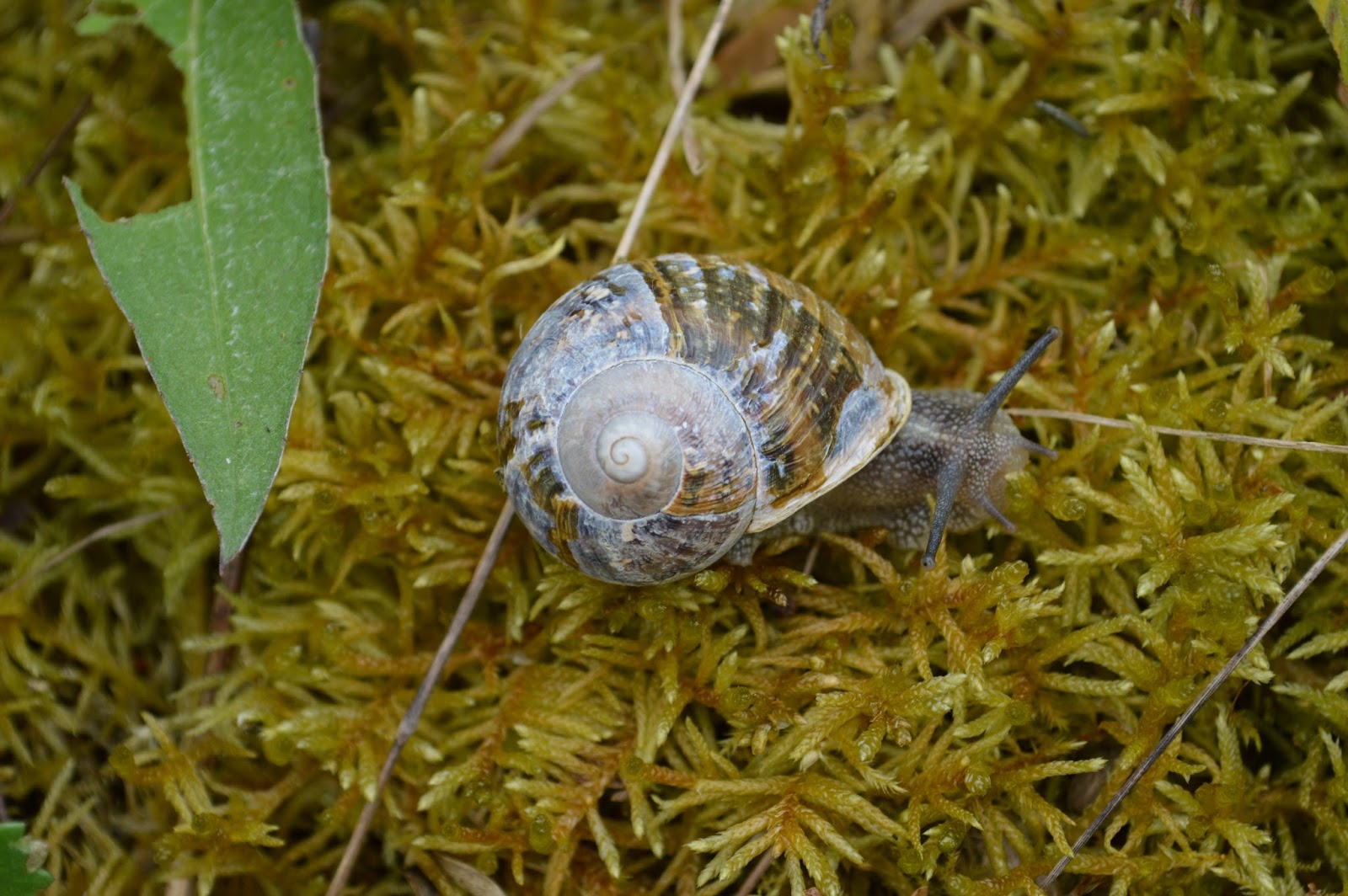
 On this occasion we went 'out into the field', literally, looking for insects. My camera is OK as Nikon reflex digital cameras go but this is one area where a much more expensive lens would have given me more impressive results. Never mind, I like getting out into nature and capturing anything interesting that I find. Some members wanted to find wild orchids. We did find some. Other members wanted to find butterflies but frankly, there weren't many. Spring has been cold and slow. Here's what I found:processionary caterpillars, 'unison' cater[illars, orchids, escargots and some bugs in various vacant plots.
 Behind the Bleury cemetery I came across some bizarre caterpillars. The first set provoked stern warnings from my French colleagues not to touch them, too dangerous. Really? Those weblike cocoons were dangerous? Very, certainly fatal for curious dogs. At best they'd end up getting their tongue cut off to save their life. Dangerous for humans too. You can see them in the photos, hanging out in their hammock-like nests. At any moment a gust of wind might have split open the hammocks so I didn't linger.
  Elsewhere things were more peaceful; snails, moss, butterflies. Nothing exciting but at least they weren't scarey. The most peaceful of all were the orchids and other plants. War and peace can be found almost side by side in a French field.





 Posts
Posts


