Monday, 8 June 2015

Hard labour

No matter what country we come from, where would homes, businesses and infrastructure have been without cobblestones, paving stones and mill stones? I live in a French town that specialised in supplying these products. But it meant truly hard labour for the employees, many of whom died earlier than they would have done in a gentler employment.


Epernon (in the Eure-et-Loir department) was, from the 19th century and even before, a town of sandstone quarries and millstones where more than 120km of material was extracted. At certain times, 40% of the population worked in open sky quarries where the production of these millstones would bring renown to Epernon from around the world.
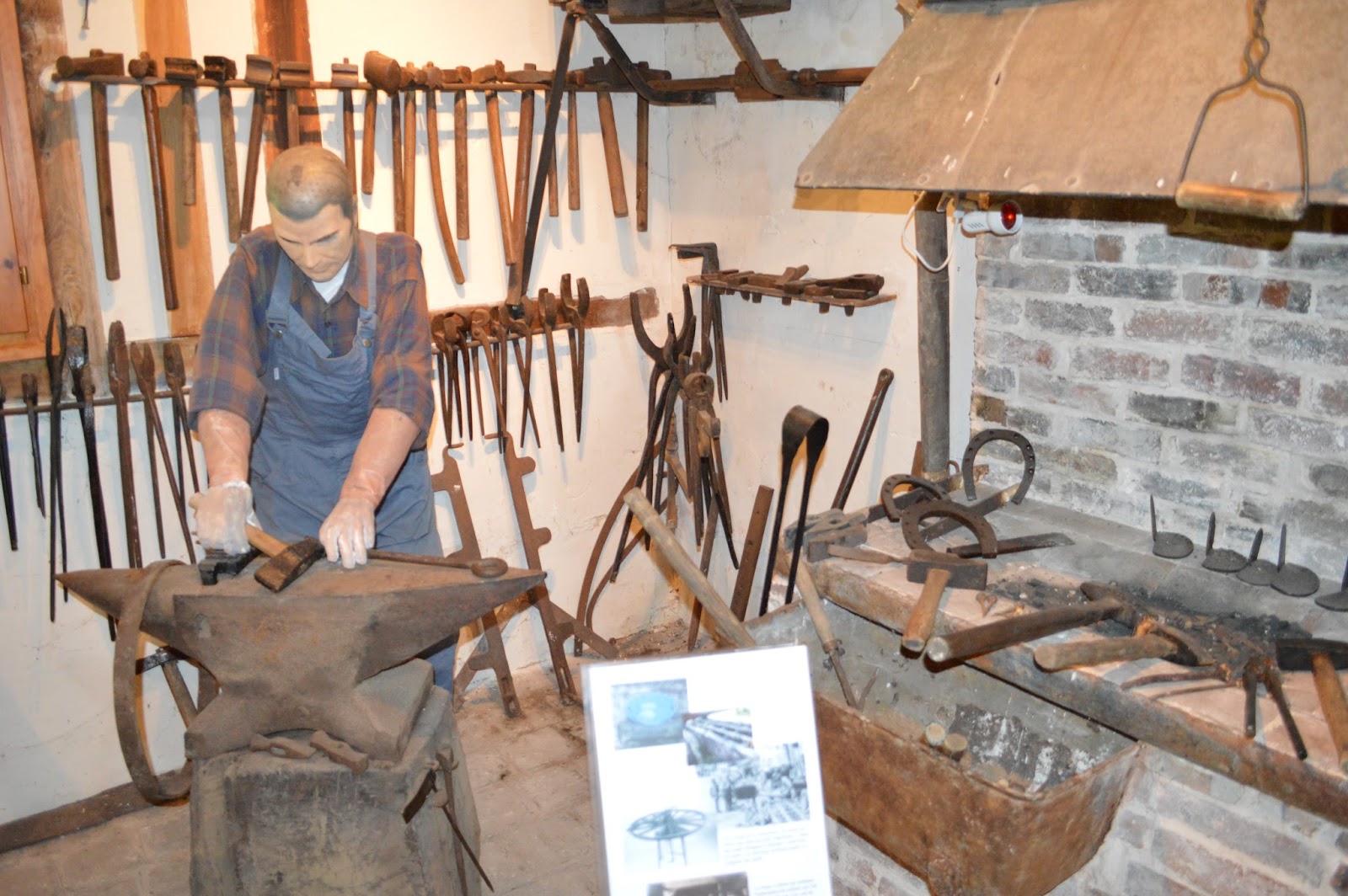
 
 It was exhausting work for generations of quarry workers  for whom mechanisation arrived a little too late, in a time where all the quarries were already almost run out. The workers were suspect to various lung and hand maladies because of dust and stone splinters. Each building block and millstone and cobble stone had to be shaped by hand, carted by hand. What a hard job. All the wind and water mills, streets and buildings needed these products. The ancient quarries can still be viewed today via a self-guided walk through Epernon and towards Droue.
It was in prehistorique times this industry would first see the light of day. Later, Vauban (the King's great civic builder/architect) himself  chose the sandstone quarries of Epernon when Louis XIV decided to divert the waters of the Eure in order to make the great fountains of Versailles gush up. Heavy barges laden with stones went down the specially channelled Drouette River that flows through Epernon, to feed the construction site of the aqueduct at Maintenon - a three-storied aqueduct built to send water to Versailles but that was never finished because Louis ran out of money thanks to his war-mongering.

I'm a member of the local heritage society  and am currently translating some of their brochures into English. It's really interesting to learn about my neck of the woods and how it fits into the events of French history. It's also satisfying to make a voluntary contribution to local tourism.

A museum display is open to the public at the Conservatoire of Millstones and Cobblestones from the Epernon Basin.

23 avenue de la Prairie
28 230 Epernon

The conservatoire is open 01 May until 30 September
Visitors are welcome every Saturday 2pm to 6pm,
Sundays and public holidays 10am-12pm and 2pm until 6pm
Other days available for groups by appointment (10 persons minimum).


Monday, 1 June 2015

How to create a potager: aka What a man will do for a woman Part 3

It was looking splendid - the potager and its attendant plots, but when Nature's involved well, it's always unpredictable.

I received a phone call from JC to say the potager had taken a serious hit. There'd been a violent hail storm over Ymeray. The hail stones were large and stayed on the ground for more than two hours, and were 2cm deep. Many of the plants couldn't handle being decapitated, shredded and  peppered with icy bullets only to be then frozen.

Sensitive plants like the cucumbers, tomatoes and especially the bell peppers were struggling to survive after the onslaught and by the time I got to Ymeray three days later the damage was even more noticeable. It was so disappointing to see what had been such an aesthetic glory was frizzled, chopped and beheaded. Even the soil structure had changed on the surface. All the hail impacts had brought the fine clay particles to the surface and it looked awful. Water no longer sank down, it ran across the ground.

I sprang into action. I dug everything over by hand, tidying what I could and I watered, deeply, to counteract the shock. It should have been done right away but that hadn't been possible. It was going to take many weeks, lots of love and attention and resowing in places where there were casualties but I was determined to get the garden's former beauty back, somehow.

In the meantime it's doing it's best to recover after a few weeks. There's also been a bird attack on my  just turning strawberries and raspberries. JC has now decided NOT to feed the birds next winter as his generosity has allowed populations to get a bit cheeky and out of balance. We found some old netting and I came up with a way to weigh it down on both sides by stapling the bottom to stakes.

The support lines for the raspberries have their own tension lines, as you can see.

Lawn clippings are used extensively on the potager as a mulch to conserve moisture, keep the weeds down and to add texture and nutrients to the soil. It also keeps the plants warmer in the evenings.

All stakes have been manufactured on site from trees that used to grow on the property. Nothing has been wasted, including off-cuts and bark. Everything has gone into constructing the garden beds.
In wet weather I can walk on the mulch or planks.

Roses have been chosen for their perfume. Invasive plants, like the mint, have been planted inside their pots to keep them under control.

Space has been used vertically to be able to garden more intensively (strawberries and cucumbers encouraged to climb).

Vegetables have been chosen not just for their food value but also for colour and form as part of garden design. Colourful veggies include the chards (silver beets in various colours), lettuces (especially the sort where you can just detach individual leaves instead of killing the whole plant), cabbages, beetroot. The artichoke was chosen for its architectural merit.

Happily I'm now seeing embryonic brussels sprouts appearing, the cabbages are making 'head' way and the broccoli is also 'coming to a head'. We've been eating lots of lettuces and radishes, salad onions and courgettes. Dreaming of my parsnips roasted and then drizzled with butter, my tomatoes and basil holding hands with slices of mozzarella on a pizza...Payback time!!

Monday, 18 May 2015

How to create a potager: aka what a man will do for a woman Part 2

It started out being a potager - decorative French veggie garden but the project grew into a complex of five beds after JC became convinced I knew what I was doing: potager, annual flower bed, tiny rose bed, raspberry bed, currant and gooseberry bed.

After the area was sprayed with herbicide Jean-Claude used his motorised cultivator and turned over the soil. Then came the construction phase.He used planks he'd made from trees he'd cut down on his property. Each plank/beam was laid on a bed of sand and anchored to the ground with reinforcing rods. Some nails were also involved but the plan was for the beds to be able to be dismantled on two sides to give access to his cultivator. He added sand and home made compost and then tilled it all together. The weather had been wet so the finished result was less than powdery but I was too impatient to wait for a drier weekend.

At this point I should add that we needed to install a dog deterrent system because Baika destroys everything. She literally eats window frames, demolishes doors, carves depressions in cement walls, flattens and digs out garden plants. This is why the door and window frames of the house and all the other garden beds are surrounded with barbed wire. I kid you not, it's unsightly like a stalag but she can't be retrained. Instead, JC carved out a channel all around Kiwi's Land and installed a cable that sends out waves to the dog collar. When Baika gets too close she hears a beep. If she moves forward a beep warns her she'll get zapped if she continues. And if she still persists she gets an electric shock. How to retrain Baika that the territory is no longer free-range? We set up small flags marking the channel to educate her as to the new boundaries. After two days of beeps and watching the flags she knew exactly where she could and couldn't go. We then removed the flags. It's highly effective (so long as you keep valid batteries in the dog collar, otherwise she gets into playing tourist).

The plantings include the following:
Artichoke, climbing beans, dwarf green beans, dwarf butter beans, peas, pumpkin, sweet potato, broccoli, Brussels sprouts, red cabbage, onions, salad onions, leeks, parsnip, beetroot, carrots, radishes, red and green lettuces, silver beet in red and yellow, climbing strawberries, courgettes, cucumbers, climbing strawberries, cherry and single tomatoes, red peppers, thyme, chives, mint, basil, parsley, tarragon.

Marigolds have been added to deter insect pests. In most cases I have used companion plantings to minimise competition and maximise cropping. Fruit trees have been planted nearby so that pollination of everything has a greater chance of success. I'm personally responsible for managing 2 apricots, 2 nectarines, one apple, a quince. JC 'owns' the rest which include cherries, apples, figs, plums.

There is also a new flower bed for annuals to encourage useful insects and provide colour during the warmer months. During winter the flower bed and potager will remain empty. JC will dismantle 1-2 sides of each to facilitate his motoculteur coming in and whisking up the soil into a fine powder.

The side bed for fruit contains raspberries with another area for black currants, red currants, white currants, gooseberries. There are blueberries in the blue and white flower bed in the background. These later beds are designed for minimal maintenance so weed matting has been laid over the top, holes cut into them and secured with nails. Then the plants are planted leaving a depression around them to aid watering and avoiding the water running everywhere other than around the plants.
The mat and nails are put in their final positions and shredded wood is placed on top. This looks decorative, cuts down light even further so weeds can't grow and keeps the beds warm.
 
There are other things I'd love to grow and a different layout I'd have liked but it's not my property so I stick with what is 'accepted'. It's certainly been a great team effort - the first time a man has put in real physical effort to help me make a garden. I never need to nag that I need something done before I can plant something. He does it straight away and the man has talent. He's made everything himself. He builds, I design and plant.

I asked him why he has gone to so much effort and expense for me. He told me he just wants to please me, and you only live once. I replied that I felt very uneasy with this because my life in France was so precarious I didn't know if I'd be here past August - it's a lot of effort and expense for just a few months. He told me he was an optimist. He must know something I don't.

For other images of potagers try this site: https://www.pinterest.com/FoyJoyBlog/vegetable-garden-design-le-potager/

Part Three will look at 'fine tuning' details and maintenance and - the rewards.

Friday, 8 May 2015

How to create a potager: aka what a man will do for a woman Part 1


Once upon a time there was a line of very tall conifers, and then there wasn't. There was a line of tomatoes instead. This is the story of how a man's idea of tidying up his property turned into something he did for a woman. Me.

Jean-Claude and I often joke about how he's got a tronconeuse (chainsaw) grafted to him. He's scarcely happier than when he's chopping down trees, very big trees, all by himself. A line of Thuja conifers  was shading his house and getting a bit unwieldy and the previous use of the land they were on wasn't relevant; things were looking very untidy. So, he proceeded to chop down each tree. Not wasting anything.

It took a year. That left a line of concrete blocks, concreted-in concrete posts and wire fencing. Removing all that was beyond him to do so in came a man with an orange digger.

Removing all the tree stumps and concrete and wire made a VERY deep and long  hole. I tried it on for size. It was big enough for a large house. Yes it was costly, but JC wanted to open up the view from his house so he could see his orchard. He loves big open spaces and hates fiddly things that take a lot of ongoing maintenance such as gardens. Mission accomplished. And there the matter may have stayed but his thoughts kept wandering to me and my love of gardening.

Every weekend for four years I've been obliged to pack a bag and move to his place in order to spend time with him because he's had no interest in spending any time at my accommodation. That means there's almost nothing for me to do at his place because I'm not such a hermit and 'I'm not a lumberjack and that's OK'.

I have a passion and talent for gardening so he started asking me advice on what to do about putting some plants in where he'd erected a fence to close off an old entry to his property.

One Friday I arrived at his place to find a very surprising sign installed that he'd made. He joked about it, that he'd give me a wee bit of space to plant some plants by his new bushwood fence and I could choose those plants, whatever I wanted. I thought it was a very romantic thing for him to do - making that sign.

We marked out the area; I showed him how to use a hose to get the curves just right, all the time wondering why men find it so hard to listen to women's ideas and accept them. Ideas get poo-pooed, then reflected on and then acted on quietly.  But, this is a man who reflects on things and tries to make me happy.


This new plant bed focuses on a predominantly blue and white theme (with a few exceptions to accommodate spare plants already available. JC hates weeding so everything has to be well prepared and then covered with a plastic mat into which holes are made for plantings. Now there's a decorative bark layer added.  It's very, very time and effort consuming as he is very particular about how to do it. This is to minimise maintenance in old age, and fair enough.

Plants include a pittosporum (to remind me of NZ) pieris, acanthus mollis, fuchsias, clematis, geraniums Roxane and Johnson's Blue, corydalis, ophiopogon planiscapus nigrescens, (black dragon grass), viburnum, roses, lupins, hostas, heuchera, ferns, shasta daisies, ajuga, rhododendrons, hydrangeas and two blueberry bushes. Everything has to be chosen to withstand the harsh winters here.

I thought that was the end of the matter but JC surprised me and himself  by then deciding to give me more land, and this time for the thing he'd insisted for years he'd never, ever have - a potager, a vegetable garden. Click on any of these photos to enlarge them.

 Next post I'll explain the construction
and design of the potager and ancilliary beds.