Sunday, 29 November 2020

Fun and Highland Games in Hororata

 November sees a tradition in mid-Canterbury - the Hororata Highland Games. It's a key event on the calendar and even this Covid-spiced year things were settled enough for it to go ahead. I didn't attend this year as I didn't feel like spending the day alone there and, in fact, I had gone last year and enjoyed the colour and the grunting.

Hororata is a small town on the Plains, 50kms west of Christchurch, sometimes famous for its very yummy pies, serving the rural community. The Highland Games started in 2011. The Hororata community wanted to make a positive change following the damage of the Canterbury earthquakes. The annual event has increased in popularity with 10,000 people coming to the 2016 event. It has become New Zealand’s biggest Scottish festival.

Bring along a picnic but leave any glassware at home as it is banned. Activities to entertain you abound: Highland dancing competitions, piping and drumming, Tug O’ War and Scottish heavy athletics (men’s and women’s) which include the hammer throw,  the Hororata stones and tossing the caber - hence the grunting. It's heavy athletic work and some women enjoy competing. Many competitors drop their stones and cabers in spectacular failures.

Also at the event are merchants' stalls, wool-spinners, medievalists, Scottish geneology enthusiasts and the famous pie-eating competition. The latter was a bit odd to me. Why would anyone want to do that? With or without tomato sauce? But, like many of the activites at The Games, you can get swept up in the fun and atmosphere. Each year the event can attract up to 10,000 visitors.

Hororata has a Night Glow event around the same time. A great many hot air balloons assemble at night, lit by floodlights and hot air burners. Spectacular.


Monday, 16 November 2020

NZ vs France health statistics 2019

 Healthcare issues usually feature in election campaigns; this year was no exception. But even before that, of course, the consequences from Covid-19 were already to the fore. New Zealand has some significant inequalities when it comes to health treatment; cancer being one example, screening for bowel cancer is another. We are so far behind other OECD countries in those areas, so I thought it might be worth taking a look at healthcare pros and cons and performance analyses between NZ and France as things stood before Covid struck. I've been through both systems personally. Firstly, just a few bits of info to give you an idea of the French healthcare system...

Pretty much everyone there has a carte vitale. This green card is presented at the doctor's or pharmacist's to inform the government you are entitled to have public-funded care and it is handled automatically. If you are employed in France 70% of your medical costs are covered so you just pay the balance at the consultation. For seniors in France who are 65 or older, or individuals with chronic illnesses such as cancer, the services are fully covered. 

To pay for additional services like chiropractors or long-term care at private hospitals, or to cover the remaining 30% of the basic care, individuals can purchase private insurance. I wish I had known that when I first arrived in France. I discovered I had to pay hundreds of euros before I could check out of a hospital there as only 70% was covered by the public system. A hard lesson and one I instantly rectified by taking out additional insurance. It's a system which means most costs for almost everyone are covered, though dentistry can still be a challenge.That means that healthcare in France is some of the most subsidised and affordable in the world but it is a big drain on the government budget.

Now, let's take a look at the statistics pre-covid 19. The main source for these statistics is Le Point 21 November 2019 which published the Panorama report from the OECD.

The OECD ranks democratic countries with market-led economies. Le Point ranked them according to FIVE themes: access to care, state of health, risk factors, quality of care, resources. Overall France was ranked 9th, with New Zealand 13th. Australia was 6th.

 Two things that plunge France and NZ into the area of risk factors for the health system are tobacco and alcohol. Two other risk areas are the high prescription rates and a lack of doctors, especially in rural areas. Mental health is the fifth risk area. It can take three months or more to get a first appointment with a psychiatrist in France. It's no better in NZ.

There are too many suicides in France, the rate is the highest in the OECD but NZ is  up there too, as we know, particularly in certain gender and age categories. Overall, France has 13.1/1000 inhabitants, while NZ has 11.5.

When it comes to general health ranking France does better; 82.6 is the average life expectancy, 154 for mortality rate of avoidable deaths/100,000 inhabitants, 4.8% of the adult population have diabetes. New Zealand has an average life expectancy of 81.9 years, 178 avoidable deaths per 100,000 inhabitants, 8.1% of the population have diabetes (sadly no surprise there, possibly due to us being the 3rd most obese country in the world).

In France and also, I am finding, in NZ the new generation of doctors, largely the female ones, have no interest in working as their predecessors did (60 hours per week) which makes it very difficult to obtain appointments in either country, especially if your doctor is a female with children, working a few hours a week. Both countries have an under-supply of GPs and other doctors.

Ease of access to care: New Zealand 5th ( 100% population coverage for primary care, 78.6% spent on public sector),  France 6th (99.9% population covereage, 77.1% spent on public sector).

As a contrast, the United States sends the most on  health for very average results.

Risk factors that are not well controlled

Tobacco: France 25.4% smoke daily, NZ 13.8% no surprises there; Alcohol: France 11.7 litres drunk per adult per year, NZ 8.8litres; Obesity: France 49% of population, NZ 66.6%.

French doctors are often hostile to any suggestion some of their tasks could be delegated to pharmacists or nurses, such as vaccinations. This is not a constructive attitude, very protectionist, whereas in NZ pharmacists can give flu jabs, as can nurses, smear tests are done by nurses etc so that doctors can concentrate their time on more complicated consultations.

Quality of care (looking at the use of antibiotics, asthma, death after a heart attack, survival after breast cancer)

France prescribes 23 daily doses of antibiotics per 1000 inhabitants, NZ 25.8 daily doses. France admits 150 patients for asthma or chronic pulmonary obstruction per 100,000 inhabitants, NZ a whopping 363. France has a rate of 5.6 deaths from heart attack per 100,000 inhabitants during the 30 days following the infarctus, NZ 4.7. France has a rate of 87 surviving breast cancer for 5 years, NZ has 87.6.

Fulltime nurses in hospitals in France receive the equivalent of 38.5 euros compared to NZ nurses 49 euros. French nurses have a guaranteed employent and good pensions but are very poorly paid. The average across the OECD is 44.5 (currency, purchase power and parity have been adjusted in these figures). 

French people judge inequality of access to healthcare as inacceptable, far ahead of the inequalities of housing, income etc, men and women. They insist on equal access for all, even if you have no money. In NZ we seem to accept that if you don't have medical insurance or are a beneficiary etc then you can expect to possibly die as a result of lack of access to good health care, including medications.

Healthcare spending per inhabitant

France spends $4964.7 compared to NZ $3922.6. There are 3.2 doctors per 1000 inhabitants in France, NZ has 3.3. The OECD average is 3.5.

The number of  hospital beds per 100 inhabitants

France has a whopping 6 beds. NZ has 2.7 beds. It seems other countries can supply good quality care for less beds than the French system. Wastage of resources represents 20% of expenses on healthcare in OECD countries. This includes hospitalisations for diabetes and cardiac insufficiency which could be treated via primary care providers, prescriptions that are not necessary, insufficient use of generic drugs. The average stay in a healthcare establishment (medical, surgical or obstetric) is 9.9 days in France, yet only 7.1 in NZ. Are we rushing kiwi patients out the door or is France being too generous?

It's anyone's guess what deleterious effects the pandemic will have on quality and type of care in OECD countries from now on but keeping the pandemic 'under control' MUST be a positive thing in terms of preserving our health systems and access.

Friday, 30 October 2020

When past and present pupils meet

Last week I had the opportunity to have a luncheon with other alumni from Papanui High in Christchurch. The luncheon was followed by a tour of the current school, guided by senior students. These events are rare and it was quite by chance that I heard about it in advance. 

I'd been chatting to an ex-Waitakere City Council colleague Darryl who mentioned the get-to-gether and so we discovered we had both gone to the very same high school, but that our paths had never crossed. Darryl had been there a little ahead of me and left just before I arrived. Alas for me, that was the case for most of the attendees. There was no-one else at the luncheon I had known during my time at the high school.

The school was originally called Papanui Technical college and opened in 1936. It was renamed Papanui High School in 1944. My maternal uncle, Eric McNabb attended while it was still a technical college. There he is in a cadet's uniform at the college.

I attended  Papanui High School from1968-72, leaving at the end of the seventh form year. I'd been a member of various choirs, the orchestra, the drama club and photography club and a chamber music group. I had continued to play the violin and was active in school productions. 

My last year there saw me in the lead role in the 'Calamity Jane' production. Some of you might think I was well cast and am still a 'calamity'. I was a big success in the production and it was one of the few times in life I felt appreciated or talented.[photos show me signing autographs while principal Ted Fancy and his wife speak to my mother, me stripping during a rehearsal in the hall and then threatening with a rifle a bar patron in the same musical Calamity Jane ] 

My school gave me an opportunity to discover aspects of myself that I still use today. That's the mark of a good school and although I was never a great scholastic talent I did cram a fair amount of experiences in and seem to have gone further than many alumni, in certain areas.

I enjoyed listening to other alumni's stories and being shown around the current school. We all reminisced constantly, sharing our recollections with our student guides because society and the times have radically changed. 

From time to time I would step back and listen in as the transfer of school history between alumni and current students picked up pace. I was watching something very important happening and I thoroughly enjoyed interacting with the senior students who seemed confident, well-behaved, open-minded and balanced.

When we had been students at the school we were streamed, depending on our IQ and academic tendancies. I was put in the professional stream, others were more commercial or technical. There was even a unique class with the prefix NM for non-maths. I never progressed maths beyond the fourth form and for my final three years I was spared the suffering of not understanding maths lessons. There were only a handful of us who were excused but we were all reasonably intelligent, just no good at maths. I wasn't much good at French either but, look where it eventually led me - life in France. My English teacher Mr Bunn married my French teacher Miss Cowie after I left.

In those days boys and girls were kept separate as much as possible, even in a co-educational environment. We found ways around that, of course. The only time I got a detention was for being in the music rooms after reasonable hours. 

A group of us were playing 'spin the bottle' and 'truth, dare or promise'. We were having a whale of a time and were not doing anything dreadful but as the group started to break up we were caught out by a member of staff. 

[See empty cloakroom and seating photo below for that very room]. It's hard to believe our orchestra instruments were stored there; my violin in its case on the seating, the double basses and cellos ranged along the walls. A smaller, separate room was used for the brass band instruments. I clearly remember my drama teacher Mr Bunn trying to encourage a younger boy and me to practice kissing there for the production of Romeo and Juliet. We were both mortified to be singled out and having to do THAT. I was a shy student mercilously tormented by the band boys because of my surname FREE. Boys can be so cruel.

Our alumni group were very saddened to see the integrity of the layout of the school almost unrecognisable. The cricket grounds out the front which had framed the main block had been replaced by ugly asphalt and cars. One key block had been amputated and flogged off in return for the use of a new gym and access to swimming. The old swimming pool was gone, instead there was a dance studio and Maori/Polynesian structure. The environs are far less aesthetic than they were, both inside and out and the principal explained it is difficult for the school, being sandwiched between a mall, big-box developments, a railway and lack of access and parking.

The school offers a broad range of subjects and even hosts an ESOL unit and one for Special Needs kids up to the age of 20. Our group got excited to see the solid materials department with so much technical equipment which includes 3D printing. "You are so lucky," we said to the students showing us around because we'd had to manage with almost nothing. 

There were plenty of ooos and ahhhs as we explored the campus, trying to orient ourselves with various buildings, but much has changed. Politics and a changing society have radically modified subject content, delivery and focus. At least girls and boys are free to follow any subject they wish. 

In my day I had no right to do technical drawing or sewing or other home economics. Girls, especially, knew they had to follow the career path dictated by their mothers. I did liberal studies in my last years at Pap and chose to render hairdressing services to ladies in a retirement home. The school paid for a portable kit for me and Langers hairdressing trained me. I did so well they offered me an apprenticeship but my mother scotched that idea. Too working class for her snobby ideas but maybe I would have had a chain of hairdressing salons and a stable career rather than the constant instability that became my reality.

I was particularly curious to see the theatre and music departments. Oh how I would love to be a student in today's times. They have their own little theatre and lighting gear. As I toured the new music rooms I saw plenty of acoustic guitars, an electric guitar, bass and drum kit but little in the way of classical instruments other than piano. There was a long table covered in electronic musical keyboards. How cool!

The former gymnasium is now a study room. There's an ICT room full of computers, photoshop and graphic design software. It really is a different world but our group agreed our level of English is vastly superior to that of modern students. 

I was stunned to be back in the old school assembly hall which was much as I remembered it. While no-one was looking, I pushed through those double doors that lead to the old music rooms and backstage and let the memories flood back. It's all old and sad looking but still recognisable. A lot of maintenance and improvements have not been allowed to happen due to rebuilding plans following the earthquakes. I climbed the steps backstage to access the stage. It was almost 50 years since I had stood on it. It felt great and entirely natural. Sooo much water has flowed under my bridge since 1972. I'm a lot more confident.

We remembered the uncomfortable wooden benches we used to sit on for assembly, boys one side and girls the other, school orchestra just in front of the stage, staff parading in while we sang the school song in latin. Crumbs! but we had respect for our elders (well, most of us did).

Large photo shows our group of alumni in the old assembly hall, me in mustard, Darryl on the left end of seating. We all enjoyed our trip back in time and into the future, interacting with students. I'd like to do more of that in future if given the opportunity.

The college in 1940. Note the space in front of the main wing which gave a wonderful perspective. Quite a bit of the space still existed when I studied there and the trees along the front on Langdon's Rd were a good size by then. credit photo  http://ketechristchurch.peoplesnetworknz.info/en/site/images/show/2586-papanui-technical-college-in-

the-1940s?view_size=medium

Below is the school orchestra in 1970, me in the top row second from right.

For those who are alumni, maybe you remember interacting with some of these teachers.


Other images of what is left of the old historic parts of the school. My heartfelt thanks to the staff and senior students for such a gift of revisiting such a key part of our pasts.


Saturday, 10 October 2020

Long-awaited party has musical beginnings

 A long-expected age milestone occurred earlier this year. Unfortunately it was during lockdown level 4 and so my party was cancelled and I just had to amuse myself that day. "Bugger it," I thought. "I'm going to do this but do it even better later on."

And so I have. Laura came down from Palmerston North to help out. It was so lovely to spend the two days with her and have fun with friends and neighbours. As I commented during my slide presentation on 65 years of Frances Harrison's existence, other than my daughter Laura, there was no-one present who had known me more than two years. That was a shame. Those who had known me for a while and were invited couldn't make it. 


Having been obliged to move around NZ and France several times, most social and professional networks have long gone. It is really hard to start over in a new place at my age so social connections are treasured.

To give folks an idea of who I am and how I came to be where I am now with so many adventures and iterations, I made a presentation, showed a video, set up a bellydance costume display in my home and, with my new musical collaborator John, did a spot of entertaining. 

I've been teaching myself bass guitar and renovating my vocal chords. Music used to be an important part of my life in the past. I have played violin in NZ and France, piano and guitar and keyboards in NZ, taught music while a primary teacher, and established St Marks School Orchestra back in the 80s (it's still going) but aging can wreck what you want to do so I have channeled my music into something new.

Bass guitar has been on my bucket list for sometime. My fingers still haven't toughened up and it seems to take me longer these days to memorise and absorb things but never mind. It has been quite the learning curve with the physical challenges with the bass, I was pretty rusty on the bass clef but these days there are so many resources free online that you can use to teach yourself. I love my instrument and practice most days. I want to find other musicians who would like to play with me. That would be so much fun!

I am now also starting to sing at various music clubs around Christchurch for performance practice. Eventually my music partner and I will launch ourselves as a professional duo. [more on that in the future].

It's great to be focussing on something old but new - a music link from the old me to the present me. I hope one day there will be many more lovely people in my life. A big thank-you to Laura and John and all my guests for their contribution to a happy day. I'm keen to see where music might take me from now on, hoping it 's never too late as there's a lot more life behind me than ahead, but it's what you do with it that matters. I was desperately needing a project and voila!, here it is!


Monday, 28 September 2020

Little-known historic Canterbury gem.

One day, as I was driving through the Canterbury Plains, the last thing I expected to see pop up out of nowhere was a historic cottage made of ... concrete.

It is in a style reminiscent of structures in France and Britain so naturally it caught my eye, standing out, as it does, on the flat Canterbury Plains. Along with two other structures in the area, it is one of only 3 buildings that remain of the Barrhill Estate. It was built by Scottish immigrant John Wason in the 1870s as the gatekeeper's lodge. The gatekeeper was responsible for opening the gates to the Corwar estate, and conducting visitors to the mansion.

Corwar Lodge is a small building of around 45 square metres, constructed of concrete and with a hipped slate roof. It has four rooms and a central chimney. The walls are 30cm thick which must have given good insulation. 

There is only one external door which leads straight into the living room, then into a small pantry on the left and a small bedroom to the right. Through that there is another small room. The internal ceilings are all tongue and groove timber. The internal layout remains original.

It was shut up the day I saw it so all I could do was peek through the windows. It needs cleaning and dusting but does give an idea of what everyday life was like for a gatekeeper of those times.

Wason's Corwar mansion/homestead was built on the south bank of the Rakaia River. He wanted a British-style estate, acting as a squire, so he built a mini village called Barrhill and planted oaks, limes, walnuts and poplars.

Barrhill Village was at first quite prosperous comprising of the Church, school, schoolhouse, a bakery, blacksmith, post office, boiling works (for mutton), store, inn and about 15 cottages. When the railway bypassed Barrhill in the 1890s, the village started to decline and Wason sold up in 1900 and moved back to Scotland. Not long after that his mansion burned down.

The small lodge fell into disrepair over the war years. Restoration was completed in 1972 and it led to the formation of the Barrhill Corwar Lodge Preservation Society. It is now the responsibility of the Ashburton District Council and can be visited on request. If you are heading to Rakia this may be worth a visit.


Monday, 7 September 2020

The art of Passementerie

I'd like to introduce you to a little-known industry where artisanship, creativity and beautiful materials combine to enliven historic buildings and homes or contemporary appartments, museums and fashion. 

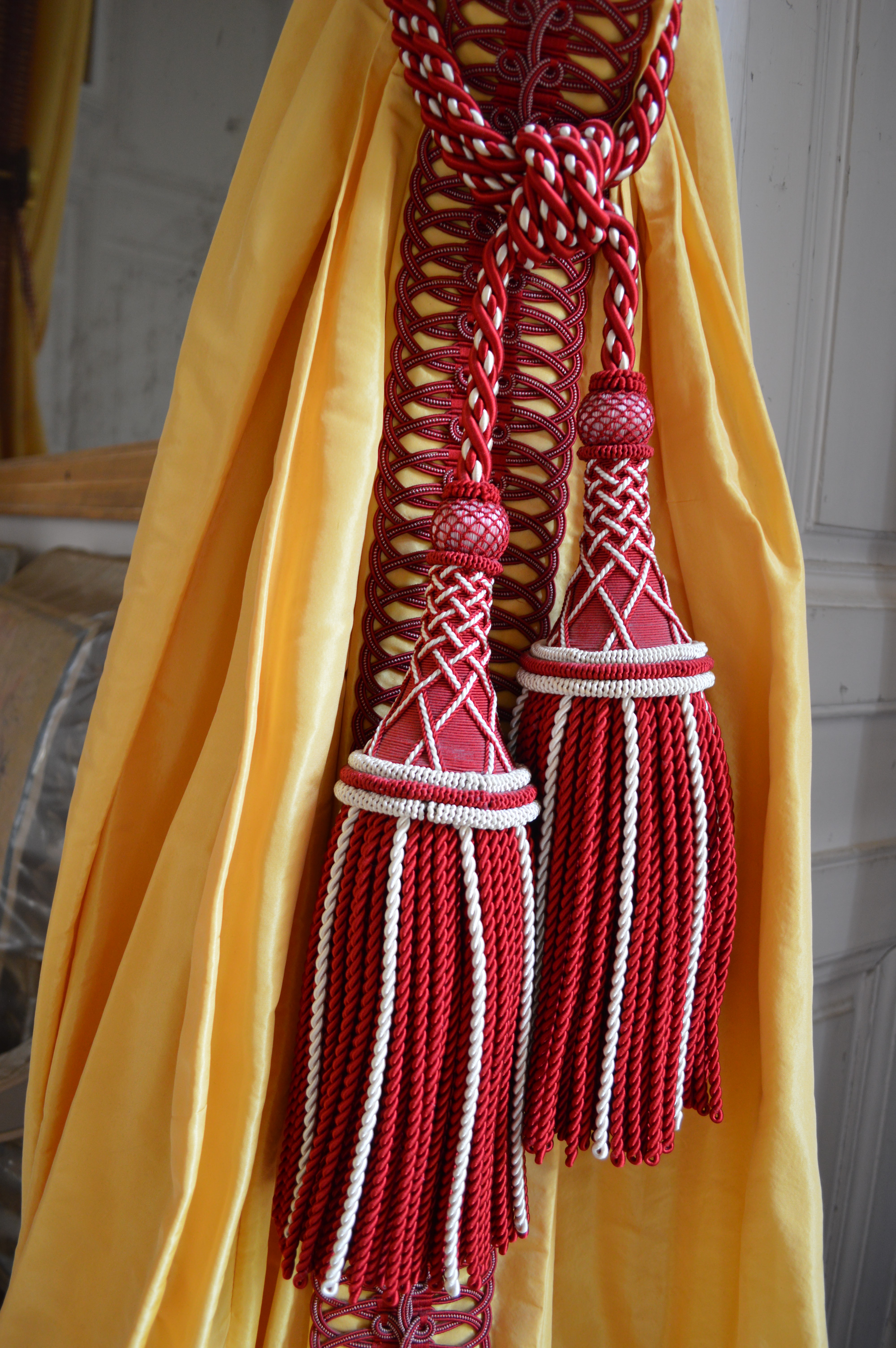
Passementerie consists of ribbons, bobbins, tassels, fringing and braids. It's an old industry that survives to this day in Europe. I first started to appreciate it while visiting chateaux in France and Royal residences in England.  

Any passementiers in the 1600s were French Protestant Huguenots who, on being forced to flee France due to religious persecution, took their skills and tools with them, thus transforming the skill base available in London. 

Today, there are at least three major businesses in Paris still manufacturing these exquisite 3D objects and trims and other businesses in other locations. Multiple contemporary uses and the renovation of historic buildings means there is a demand for these products. Much of the work is done by hand, as well as using looms and other mechanical devices.

I discovered an order book of passementerie in Millers Home Centre, Christchurch, while I was in the throes of designing the interiors of my new home under construction in 2018. Curtain tiebacks (embrasses) were priced at around $120 each. Hmm, I hesitated. Yes it is pricey but they had to be ordered from Paris and the workmanship and detailing was outstanding. I waited a couple of months while considering various decor options.  

I went back to Millers but couldn't find the book. I was informed they would no longer order in as volumes were too low. I had left my decision to proceed too late. Instead, I had to make do with the cheap and nasty stuff available from Millers. Mass-produced in Asia at $15 each, and they look it. Sigh! I had the same problem trying to find trim for reupholstering two antique French armchairs. No retailer had anything suitable. My upholsterer had a very limited choice but we did manage to choose a trim that could match the fabric.

While in France I would come across situations where passementerie had been essential decoration in the past: fringing and tassels for royal carriages and hearses, decorations for horse bridles and carts, curtain decoration, lampshades, bed and cushion decoration, upholstery, fashion accessories, jewelery. The Victorians loved tassels and bobbles and these items were widely used in NZ up until around 1916 when they fell out of favour and were associated with 'stuffy old things'. There is currently a resurgence as fashion houses use more and more of these exquisite decorations to distinuish their designs.

Their manufacture is interesting and I include the link to videos you can watch. No wonder the 'real macoy' is expensive but worth it.  https://www.youtube.com/watch?v=WxLLByW8O_Y

https://www.youtube.com/watch?v=_CXb7GPKHjQ 

And this guy was voted best artisan 2011- lovely work https://www.youtube.com/watch?v=KDVtWtN8oSk

First up is research for the different materials needed for each order. The threads are grouped by width and quality, in appropriate color tones and according to use. If the dyed material cannot be found in existing stock, the raw materials are dyed. After dyeing, they are spooled.

The next step is preparation of the threads on the loom. If the item is composed of decorative ornaments, these are prepared with le retordeur, the mechanism for twisting threads.

Some materials are destined for the mechanical loom: first carefully threaded onto the loom as the pattern requires. The mechanical loom enables the creation of ribbons, braids and bullion fringes.

Still other materials are destined for the work-table, where items are assembled by hand without the use of looms: for example tassels, complex gimps.

The last step is the production itself: weaving on a Jacquard mechanic loom, hand weaving or at the handwork table. 

You can buy quality work online and see examples on eBay and Amazon. There are heaps of photos on Pintarest. You can also teach yourself to make simple tassels via YouTube. You'll be learning a whole new vocabulary too.

The photos are those I have taken to show you some ways passementerie is used. They include from sites such as Versailles and Fontainebleau. Queen Elizabeth wouldn't let us take photos inside Windsor Castle to show off English versions.