Wednesday, 29 January 2020

Aigues-Mortes - medieval shopping

Travelling from Carcassone to Arles, we decided to stop off in medieval Aigues-Mortes on the edge of the Camargue delta.

Aigues-Mortes is a fortified town and is located some 90 kms  northwest of Marseille. By road, Aigues-Mortes is about 33 km (21 miles) southwest of Nîmes and 20 km (12 miles) east of Montpellier.
it is is connected to the sea through the Canal du Rhône a Sète. It's not well known outside France but has a lengthy history.

Salt mining started from the Neolithic period and continued in the Hellenistic period. Later, the exploitation of the Peccais salt marshes was encouraged by Francois 1 in 1532, to connect the salt industry of Aigues-Mortes to the sea.

In 791, Charlemagne erected the Matafere Tower monastery which forms part of the current ramparts.

Aigues-Mortes, as much as it appears today, was conceived by King (eventually 'Saint') Louis IX in 1240, and the walls were finished by his son in 1302. It was built to give Louis and his armies access to the sea, at a time when his younger brother Charles (King of Naples and Aragon) occupied the coast to the east (Provence) and south (Roussillon). His new town grew to become one of the most important strategic ports on the Mediterranean. It was a great launching off point for Louis and his navy, keen to conquer and plunder the Holy Land.
Louis launched the Seventh Crusade in 1248 and again for the Eighth one in 1270 for Tunis where he died of dysentery.

From 1575 to 1622, Aigues-Mortes was one of the eight safe havens granted to the Protestants. But in the time of Louis XIV the revocation of the Edict of Nantes in 1685 caused severe repression of Protestantism. The Constance Tower was used as a prison for the Hugenots who refused to convert to Roman Catholisism.


What the town does today:
  • Viticulture and asparagus
  • Breeding of bulls and of Camargue horses
  • Production of salt by the operation of the saltworks 
  • The ramparts stretch for a distance of 1650 metres. Spectacular in their height and their state of preservation even though they were not restored in the 19th century
  •  Ernest Hemingway's third major posthumous work, the novel The Garden of Eden, takes place in Aigues-Mortes
  • During summer, tourists come to buy slabs of local nougat, Gardian cowboy hats and post cards of flamingoes
  • The etangs (salt-water lagoons) surrounding the southern end of Aigues-Mortes are red, and they are so because of the high-concentration of salt within them. 
I found the highlight of my visit was  a little shop selling Provençal fabric and home linen items. Quintessentially the South of France. I came away with beautiful table mats and tablecloths, and a teatowel the owner threw in for free.
https://www.facebook.com/Tissus-Proven%C3%A7aux-Les-Remparts-106139846129851/  Most appreciated. Yes, it is very touristy but it is lively and there seemed a better quality of merchandise with a splash of creativity here.

For us there was a huge downside to the tourist success here. On a blustery day we were keen to take a quick peek around the town and then head off to our true destination, Arles, for the evening. Unfortunately traffic control was a horror. It was reduced to one lane trying to turn right while traffic from the other direction tried to turn in. There was also a barrier arm. Total gridlock occured with visitors trying to leave in their cars but unable to.

The entire carpark avenues became full of stationery cars that needed to leave but couldn't. Tempers frayed amongst drivers and courtesy evaporated. I got out of the car to see what was the problem but there was no accident, no cardiac arrest, just incompetent traffic management which meant we had to sit in our cars for 1.5 hours with the aircon running to keep temperatures reasonable. That rather spoilt the experience, but on a quieter day I'd recommend a visit here - a stroll along the ramparts (which are lengthy, taking 45 minutes), shopping and chilling out in the numerous cafes. There are plenty of Provençal soaps in delicious perfumes to be sampled too. Weekly markets are on Wednesday and Sunday mornings. BnBs and vacation rentals mean you can stay here and explore the Camargue as well as Roman remnants in the general area, at your leisure.

Sunday, 12 January 2020

What dreams may come

Here we are and the first month of the new year is already rushing by. Each year I hope the new year will be better than the last one. This is rarely the case in my experience but 2020 has a certain ring to it and is currently giving me a little encouragement whenever I pause for reflection.

Last year was truly unpleasant. It began with possums eating my little orchard and roses and even parts of my new house. I lost money, time, effort and sleep. I had to learn a lot about various forms of killing and so The Aussie Terrorists died after a concerted trapping and communications campaign. My nerves were entirely frayed and some of my fruit trees have not recovered.

I had two different landscapers try to rip me off with charges, knowing I didn't have anyone behind me to back me up. My sense of trust took another hit. They had to back off; a quote is a quote.

One of the biggest frustrations was my continuing search for employment throughout diverse sectors. I have plenty of skills, talents, qualifications and experience and, of course, NZers aren't interested in experience gained overseas by candidates. It's a hiding to hell with years of my life wasted in applying, researching and interviewing, but the worst is the emotional toll it takes, especially when you are unemployed for most of two years while trying to build a house on your own.

Jobseeker benefit is not designed for people like me. The WINZ work broker said she could not help me; too educated, too experienced, too old. But too young for the superannuation.

And then there was the worst horror of all. The utter and tortured betrayal I suffered in going back to France to spend time with JC, believing his past words of love, marriage, when all along he'd decided on another woman. It's not the sort of thing I will ever forget and it still affects me on a daily basis. Trust. It's hard to trust anyone after that and we all know there are a lot of fake people out there. I meet them regularly.

But all that is being mitigated by some surprising positive stuff which may or may not pan out, but at least I am seeing possibilities.

My garden is progressing, despite serious damage from hail and relentless strong winds. Little by little it is coming together and I am a long way from 12 months ago. Lots of hard work and caring for my plants is paying off in scrummy fruit and vegetables that improve my health and supermarket bills.

Recently I reconnected with a bass player I met back in the eighties. I turned him down back then about joining his band as a vocalist on keyboards as I didn't feel I was good enough. I wasn't, without support of a music teacher or vocal coach. However, thirty-four years later we are looking at the possibility of forming a duo to entertain around certain traps, using today's technology which does away with a 5-piece backing band. I still don't think my voice is good enough but I can at least find out one way or the other. That's exciting. Opportunities don't pop up often so I'll just have to be brave and plunge in. You can imagine me at home, singing away with midi tracks on my PC, trying to find my voice again. Not much money in it but it might be fun to be musicking with someone else for a change, rather than pottering at home alone with my guitar. Can't do much until I turn 65.

I still haven't totally given up on my desire to help folks live more sustainably and to find an organisation who might discover a worthy vision as New Zealand's eco-city did back 10-20 years ago. I know I could make a diffrence and do something meaningful if only someone would choose me. I've found someone who would like to help me pursue that so maybe I can realise that dream, or not. We'll give it a go.

My daughter Laura and I spent time together at Christmas. Since then we have had more regular communication and she has been showing me she thinks of me and cares. That's lovely and an especially positive thing to develop in 2020/this year. I hope we can find ways to meet up more than once a year though travel in NZ is awfully expensive.

In the meantime, JC continues to want contact with me. It's a double-edged emotional sword for me. It hurts, but at the same time, knowing he is still out there and valuing me in some way is stabilising and helps me feel better, even if it is momentary. From time to time he sends me a parcel to help me out in some way: it might be some historic china, or a tapestry made by his mother or some bird netting. I don't know how long it will last. Reason would say he'll get bored one day, even with our weekly Skype calls across the planet, but... sometimes people can be positively 'unreasonable' and surprise us. I miss the good parts of the relationship we had.

As you can see, I still have dreams: France is in my soul each and every day and always will be - it's who I am and where I so want to be.
 I am meeting people who come in and go out of my life for various reasons - sometimes I only meet them a couple of times, I'm still working towards meaningful contributions to my district, I'm hoping a truly special man will find his way into my life one day, and in a few months time I will become 'respectable' and eligible for NZ Superannuation.

The big thing for me to focus on this year is to meet people, preferably people who know who they are and what they want, not fake people who never deliver. Spending time with people who actually value me is increasingly important. There aren't many but they know who they are. My heart is welcoming more into my life. 2020 - I'm ready to accept the opportunities in store.

Thursday, 26 December 2019

The Gorges du Tarn - quirky


One way to head down to the South of France from the more North of France areas is to go the scenic route though the Gorges du Tarn. There are breath-taking cliffs with precariously perched houses, calm waters are ideal for discovering the joys of family canoeing, while the bubbling rapids are the source of a large number of activities: rafting, canyoning, kayaking,  to satisfy the adventurous. If you are more a heritage and culture lover like me you won’t be disappointed by the historic remains, châteaux, fortresses and churches which line the gorge.

Before we arrived there, we stopped off at the Garabit Viaduct (Viaduc de Garabit) which is a railway bridge spanning the Truvere River in the montainous and central Massif Central region. This outstanding bridge was constructed between 1882 and 1884 by Gustave Eiffel (yes, he of the Eiffel Tower fame). It was opened in 1885, and is 565 m (1,854 ft) in length and has a principal arch of 165 m (541 ft) span. It's worth a photo stop if travelling through the area.


The northern end of the classic "Gorges du Tarn" route is at the small town  of Sainte Enimie, from where it is either possible to continue up the Tarn valley as far as Florac, or turn north towards Mende, or south to the Causses and on down to the Mediterranean coast. We started at Florac. Our accommodation there was pretty awful but things improved as the trip progressed.

Canoes and kayaks can be hired at numerous points in the Tarn Gorge, especially at Sainte Enimie, La Malène, les Vignes and le Rozier. At la Malène, there are also boat trips on the Tarn river for groups of up to 8 people.

The town is very quaint. Some of it is on the flat but be prepared to walk on steep cobbles if you want to explore such small towns along the Tarn to discover their very real charm.

Cirque du Navacelles  is a geological oddity. A river eroded the bottom and left an oxbow lake which later dried up, leaving silt deposits and thus the only arable land for miles around.  It is set within a great canyon. There's a bit of a tourist centre above it.

Descend to the Cirque at your own risk. I found it really freaky and clutched the sides of the car seat the entire time we drove down and back up. This road leaves little room for error but most of the time Jean-Claude wasn't phased. Meeting a car coming the other way was, however, something that had him appreciating his own mortality.

 Roads in the area are very poorly maintained and are only wide enough for one vehicle. In order to pass the landform, a dangerous, but exhilarating, road which weaves down into the valley and clings to the sheer cliff face on the way back up must be braved.

This road is one of the most famous balcony roads in the country. A balcony road is a hair-raising lane cut into the sides of sheer cliffs. It’s a unique site in France, forming a natural amphitheatre with its tall limestone cliffs. There are residences at the bottom but they are in poor repair. The hair-raising trip down and up is NOT worth the trouble. Best viewed from way above.

So, take time to explore the central part of France on your way down to Millau or further South.


Sunday, 15 December 2019

Nîmes - a mixed bag

Nîmes is known as the French Rome and became a Roman colony sometime before 28 BC. It was a regional capital and numbered  some 50,000–60,000 inhabitants. The Visigoths finally captured the city from the Romans in 473 AD.

I've been keen to visit Nîmes for a long time but when I eventually got the opportunity I was, for the most part, disappointed. I was especially disappointed by the arena which dates from the end of the second century.

The arena is in reasonable condition but is extremely dirty on the outside, worse than the smaller arena at Arles. The thing that irked me the most was the galvanised fencing around the seating level. I found it ugly and totally detracting from the ancient monument though I realise it's for crowd control during events.

There are several levels to explore if you are moderately fit on stairs. Not quite as big as the Colosseum in Rome, it is still just as impressive with its elliptical shape and  21-metre high façade composed of two rows of 60 arches surmounted by an attic. By taking one of the five concentric, vaulted galleries and passing though a vomitorium, you can  sit in one of the 34 rows of seats that can accommodate up to 20,000 spectators.

Twice a year Nîmes hosts one of the main French bullfighting events. Not something I would want to encourage.

I thought the small exhibit on gladiators needed a lot of work and dusting for its own credibility. There's more to see at this arena than at Arles but the elegant Roman charm is missing, for me. Other sights in the city give a better indication of its classical past, before it was invaded by visigoths and muslims over the centuries.

The highlight of a visit to Nîmes is the Maison Carre, a small Roman temple dedicated to the sons of Agrippa and built around 19BC. It is certainly one of the best preserved Roman Temples. Its preservation is due to its conversion to a church in the 4th century which spared it from destruction when pagan temples were being felled elsewhere, during the early years of the Christian era.

The capitals show beautiful detailing and it's hard to appreciate they have stood for 2000 years and all the human history that has swirled around them.
Inside there is nothing to see. It is empty except for the opportunity to watch a short video about the history of Nîmes. It is worth watching it.
     
Les Quais de la Fontaine - the embankments of the spring that provided water for the city, the first civic gardens of France - were laid out in 1738–55. I enjoyed wandering around but seemed to have been bitten by insects which rather took the gloss off. At the end of the Quai there are the Jardins where you'll find regal balustrades, broad stairways, statues and marble vases.

When the Jardins de la Fontaine opened in 1745 it was one of Europe’s first public parks, and came about after attempts to channel the natural spring led to the discovery of a temple to Augustus and theatre.

The site is called the “Temple of Diana” although the exact purpose of the building is unknown – it was possibly a library instead. The temple suffered damage by fire in more modern times. In short, the city is worth a visit, cherry-pick the sites and move on to, perhaps, the Pont du Gard.


Sunday, 1 December 2019

Chaumont sur Loire - odd mix


Chaumont has a particular place among the châteaux de la Loire. It has a long history through the centuries from around the year thousand until now. It's not one of the top 5 to be visited but should certainly be on the B list. These days it focusses on events such as outdoor art festivals to attract visitors but there's plenty to see. This year marked 500 years since the Renaissance and the Loire Châteaux were making the most of the marketing opportunities.

The château stayed in the Amboise family for 500 years. Then, in 1465, Louis  XI had it burned to the ground to punish Pierre d'Amboise who was embroiled in a revolt against the king.

Eventually Pierre got back in favour and had his land returned to him whereby he set about rebuilding. The North wing (now gone), the West wing and the tower and the first bay of the South wing were part of a defensive building campaign with rampart walks. In the next century more Italian influences were introduced with a woman's hand.

Catherine de Medici, who married King Henri II, bought the château in 1550. The estate was highly profitable at this time due to a toll on the Loire River and farming activities. Legend has it that it was at Chaumont that astrologer Ruggieri predicted the end of the Valois dynasty in France, in favour of the Bourbons, beginning with Henri IV.

Catherine demanded the return of the Château de Chenonceau (occupied by her late husband's mistress) and in return gave Diane de Poitiers Chaumont, Chaumont owes much of its current appearance to Diane though she rarely stayed there, having her own estate at Anet.


One can visit Diane's bedroom and small dressing area in a turret and they look much as they would have in her day. The travelling trunk was very detailed and the bed carvings first rate. Her initials are everywhere.

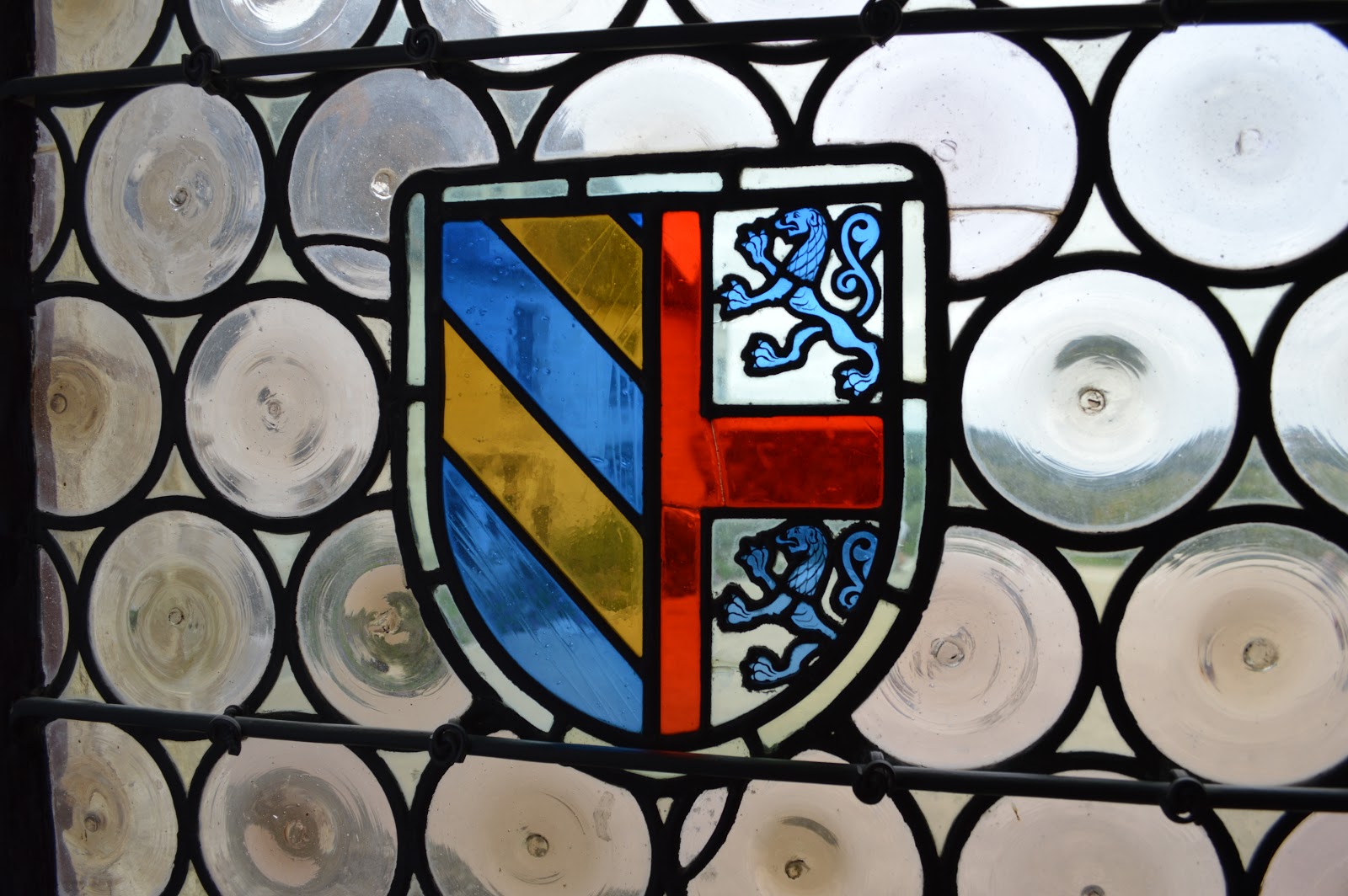
Other areas of note include the dining area with attractive tapestries and a really lovely tiled floor, original, still very much adding a quality touch; the crests included in the window panes; the stables which are still in good condition, and are probably still used; the carriage storage which was in a dreadful state of presentation (smothered in dust); and rather odd artworks scattered about the buildings and grounds.


I overheard a tour guide explaining to a group of visitors that the chateau contains a very good collection of furniture and furnishings from the 19th century, particularly the trio of armchairs designed to facilitate some very close tête-a-têtes. Apparently they are quite rare. Certainly these ground floor rooms have a very 'Victorian' feel even though this is France.

Chaumont's landscaped grounds are a fairly recent creation compared to the chateau itself. Work was carried out in 1880 in favour of vast 'English-style' leisure grounds. Owner, Prince Henri-Amedee de Broglie bought up all the village buildings located in front of the château and demolished them. He funded the rebuilding of a new village on the banks of the Loire, the church and presbytery were added. Even the cemetery was moved.

Grandiose ideas don't always come to fruition. In 1903 the Broglies had a blueprint for a model farm drawn up and work was begun which went on for 10 years but was never completed (reminds me of Louis XIV's unfinished aqueduc fiasco).

Marie-Charlotte-Constance Say was heir to the Say sugar refinieries and was the last private owner of the château from 1875-1938. She headed up one of the greatest fortunes in Europe, bought the château in 1875 and married Broglie when she was only 17 years old. The changes they made to the château welcomed Edward VII of England, Don Carlos of Portugal, various maharajas and artists/actrices including Sarah Bernhardt.

Bad speculations by a director of the sugar factories damaged the family fortune and after the death of Broglie, the princess was careless with finances, on top of the Wall Street Crash. The estate was subdivided down to only 21 hectares and in 1937 the French State took possession of Chaumont, its tapistries and historical furniture. The estate then changed from a national monument to a regional one in 2007.


There were rooms along one wing that struck me as rather odd. They were full of old 'junk' scattered about to look 'nostalgic'? It gave an ill-kempt and gloomy air. Again, dust everywhere. Further along in the wing were the institutional 19Century servants quarters, empty and totally run-down.

Visiting Chaumont gives a good view of some things and rather a jarring view of others. The upkeep must be horrendous but still... get rid of the dust. Get some local schoolkids in to help.


Tuesday, 26 November 2019

27th November - the saddest of anniversaries

Most people live long enough to lose someone close. Many people lose the futures they had mapped out for themselves. You will probably relate to my struggles today.
The first time 27 November made itself particularly known to me was the day I gave birth to my first daughter, Aimée in 1989. A vigorous little girl inside me who may have been a lot like me but I will never know. She died as we were waiting in a lift to go up to the operating theatre for an emergency caesarian. I knew at that moment she was gone. It seemed a tenuous psychic link just faded away. No matter how frantically nursing staff hammered on the lift buttons or worked on her aggressively and almost heroically on the table, they had acted far too late. Too much complacency and incompetence at St George's Hospital was carefully hushed up.

We know the medical fraternity closes ranks in situations such as this, to support each other, but there was no support for Aimee and I was left with a lifetime of mourning which I push to the back of my mind most days but which I will never get over. The pain doesn't diminish with time when a child dies.

I so vividly remember being doped up on morphine and having my wheelchair wheeled into the chapel and then the burial site. I went back to that site today to pay respect to that litttle girl and I regret we never got to look into each other's eyes and really see each other, even for a moment.

The wind was very blustery, but as I left Memorial
Park the jam jar of lemon, scented Teasing Georgia roses nodded and stayed put til after I had gone.

Driving home in the car I reflected on a different 27th November. This time it was 2017.

That's the day I left France to return to New Zealand. My dream and seven years of effort up in smoke. It was another mourning where the pain also never diminishes. I had to come back principally because NZ won't let you have your superannuation retirement unless you destroy your new life and relationships to come back to be resident here - just so you then have the right to apply for retirement at age 65.

Having been a tax payer in NZ since the age of 15 I find that rule immoral but there is no getting around government rules, no matter how draconian. You can't stay overseas and apply for it, as you can in more enlightened countries.

Everyday I miss France, knowing I am not where I need to be but lacking the means to do anything about it. I thought I had been given a reprieve earlier this year, when I went back for three months, but it was smoke and mirrors and only deepened the distress I feel. https://francesbigadventure.blogspot.com/2019/08/when-dreams-die-twice-man-behaving-badly.html

These key events in my life are the hardest deaths to manage because they aren't really manageable and it isn't helpful when folks say "Don't look back." The 27th of November is such an important part of my story and who I am that I will not be able to amputate it from my memories. Aimée and my sojourn in France remind me of who I am.