Saturday, 8 April 2023

Art Deco Napier before Gabrielle

 I was curious to visit Napier because it is famed for its Art Deco architecture.

Several towns in New Zealand, including Napier and Hastings, were rebuilt in Art Deco style after the 1931 Hawke's Bay earthquake. It's an amazing snapshot in time.  Many of the buildings have been protected and restored. Napier has been nominated for UNESCO World Hritage Site status, the first cultural site in New Zealand to be nominated

Art Deco took its name, short for arts décoratifs, from the Exposition Internationale des Arts Décoratifs et Industriels Modernes held in Paris in 1925. New materials and technologies, especially reinforced concrete,  were key to the development and appearance of Art Deco.

At its birth between 1910 and 1914, Art Deco was an explosion of colours, featuring bright and often clashing hues, frequently in floral designs, presented in furniture upholstery, carpets, screens, wallpaper and fabrics.

The art movement known as Cubism appeared in France between 1907 and 1912, influencing the development of Art Deco. The Cubists, themselves under the influence of Paul Cézanne, were interested in the simplification of forms to their geometric essentials: the cylinder, the sphere, the cone. In the 1920s, travel posters, made for steamship lines and airlines, became extremely popular. 

By the 1930s, the style had been somewhat simplified, but it was still extravagant.

American skyscrapers marked the summit of the Art Deco style; they became the tallest and most recognizable modern buildings in the world. New York City's skyline was radically changed by the Chrysler Building in Manhattan (completed in 1930). The Chrysler Building was soon surpassed in height by the Empire State Building (1931), in a slightly less lavish Deco style. These two buildings plus other Art Deco ones tofollow completely changed New York City's skyline.

After World War II the style largely vanished, except in industrial design, where it continued to be used in automobile styling and products such as jukeboxes and certain household items, reflecting a more modern feeling for luxury.

One of the best known and certainly the largest public Art Deco sculpture is the Christ the Redeemer, by the French sculptor Paul Landowski, completed between 1922 and 1931, located on a mountain top overlooking Rio de Janeiro, Brazil. You probably didn't realise it is Art Deco. I didn't when I was there.

After the First World War, Art Deco buildings of steel and reinforced concrete began to appear in large cities across Europe and the United States. In the United States the style was most commonly used for office buildings, government buildings, cinemas, and railroad stations. Many of the best surviving examples of Art Deco are cinemas built in the 1920s and 1930s. In the late 1930s, a new variety of Art Deco architecture became common; it was called Streamline, or, in France, the Style Paquebot, or Ocean Liner style. Buildings in the style had rounded corners and long horizontal lines; they were built of reinforced concrete, and were almost always white; and they sometimes had nautical features, such as railings and portholes that resembled those on a ship. 


Most of these Art Deco elements can be seen in Napier's public buildings and residential homes of the period. Check out the horizontal stripes, arches, floral details. rounded corners, geometric details. 

The street signs are in the Broadway font to suggest Art Deco styling such as was used in concert posters.

 Note the amazing internal details and external details on the front door of the old Tobacco Company in Napier. 


 The detail on the doors is wonderfully botannical. It fits so well with the other deco elements. Who would have thought geometric designs and flowing florals could work so well together?


The residential areas of Napier also reveal their Art Deco elements, mostly stripes, geometric design and rounded corners, flattish roofs. In one entire street, most of the homes, now more than 90 years old, are built in this same style. The street also houses an impressive row of mature pohutukawa.

There are buildings, both residential, civic and industrial, scattered around New Zealand in this very distinctive style but nowhere but Napier and Hastings is there such a concentration that the cities are famous for this style of architecture. And the fame is well deserved.


Not all the homes are well maintained but most are.


The archways and other structures along the esplanade display a subtle use of Art Deco elements. Also evident in Napier is a particular style of Art Deco I had been unaware of and that's the 'Spanish' influence. Several buildings on the main streets reflect this. Check out the photos below and see how many elements of Art Deco style you can now identify.


Wednesday, 8 March 2023

One year on from heart-stopping moments

Yesterday marked a year since my double open heart surgeries. Though I am a member of two Facebook support groups for this I do not identify as a ‘Heart Warrior’ or a ‘Zipper’. I prefer to put it behind me, despite multiple setbacks. It’s just yet another of my grand adventures. But this first anniversary does deserve some reflection. 

 I am grateful to have been completely unaware of the drama that was unfolding, especially of the reasons for the second opening-me-up and then wiring my chest back together. I do not remember ICU. I do not remember the post-op transition ward. I remember only some of my two weeks on the cardiosurgical ward. Some of it is muddled due to hallucinations and my brain and body focussing on other priorities.    

During those brutal surgeries I did not see a tunnel with a light at the end. I did not see angels or hear a voice telling me to stay or go. There was simply nothingness. Medical staff seem to have had some difficulties getting me to wake up. I suffered atrial fibrillation for most of my stay there and one of my first memories is of wearing a Holter monitor around my neck which sent my heart data live via telemetry to a base station somewhere in the hospital. I remember being conscious of my hands for the first time and seeing strange bulbous, yellow stumpy things attached to huge arms. There was significant oedema. Most days I slowly got better. I was determined to reclaim a life.

Though I seem well now I would not say I feel ‘normal’ as I have probably never been that, heartwise. I get tired easily and hot weather is particularly taxing. Despite having a new replacement mitral valve, the years of heart over-effort have created some negative changes to the structure of  my left ventricle. Maybe it will remodel itself now, or not. I am very aware of everything my heart does: every beat, squirm, heart rate. It is not always comfortable in my chest and reminds me it is not always at ease with itself. My surgeon told me, on the only visit I had from her in the hospital, that my heart had not liked being manhandled. On the 8 March 2022 my heart which had faithfully tried to keep beating for 66 years was stopped, twice. It was manhandled as necessary during the operations and restarts but it didn’t like it and threw wobblies (arrhythmias). Some of us have hearts that are particularly sensitive to being touched. Apparently that was the case for mine, she said.

During some of my more difficult challenges and setbacks through the long recuperation and doing all I could to help myself improve, I did wonder if it would have been better to have just not survived that first surgery. I wouldn’t have been the wiser. My affairs were in order. It’s a normal reaction, but if life has taught me anything it is that you can never see around the corner and just maybe there are things worth doing and enjoying as I go along. Hang in just a bit longer and see what good might happen. I have been given a year of life I would not have otherwise had. Perhaps there are many quality ones ahead.

I have dreams and hopes which others would find far-fetched or even reckless. I have survived tough stuff throughout my life and my heart surgeries may not be the last. It is probable I will have to face more heart surgeries in the future because my new valve will not last. In the interim I want/need to fill my life with wonder, excitement, doable challenges because without them it’s stagnation and not really living. I don’t want a non-life in some sort of holding pattern which so many settle for as they get older so I'm trying my best to be the healthiest and strongest I can be.

Coming back from the brink means, for me, making the rest of my life count for something. Love, in all its forms, is the means. I’ll follow my heart as it has followed me, and hope we will together find comfort and contentment along the way.


Tuesday, 21 February 2023

Gibbston Valley Winery Rock Concert

 I had never been to an outdoor rock concert out in the countryside before. The last concert I attended outside was at Addington, Christchurch in 1985, Dire Straits, and there was nowhere to sit down and I'd had no chair. I went on my own.

Gibbston Valley Winery 2023 had things pretty organised. If one didn't feel like driving to the venue and being locked in a sea of cars one could take an organised bus from Queenstown School to the venue which is a good 20 minutes away. From there there was a bit of a walk with folding chairs and other comfort paraphenalia, squeezing past folks already installed on the grass or standing on the gravelled dance space in front of the stage, and then getting settled oneself.

I was there principally to see ZZ Top and their new lineup which these days includes Elwood Francis on bass guitar, but I was curious to see and hear the other rock acts; The Angels, Stone Temple Pilots, Pat Benatar and Neil Giraldo. As a rock bassist I already play numbers by The Angels and ZZ Top and was hoping those numbers would be included in their setlists.

The weather was warm, to say the least as The Angels took to the stage. I'm very familiar with one of their songs and they did play it. It was acceptable but I was distracted by the current lead singer. Early in their set he gave me the impression of being under the influence of something - drugs, alcohol? I don't know but he almost tripped over his own feet three times within the first number. He gave the impression of trying too hard, deliberately setting himself onto the drum riser in order to jump off. It looked premeditated and screamed 'Look at me!' I was not impressed and just sat there in my camp chair, feeling increasingly heated.

Now it was time for Stone Temple Pilots. I don't know the music of this group but they were polished and definitely hard rock, as was their frontman. However, as they left the stage I was not inspired to check out their musical offerings online.

Each group seemed to have been allocated approximately one hour, with a half hour turn-around for the technical crew to break down and set up for the next act. Generally that went smoothly and the audience had easy opportunity to visit toilets, merchandise tents (anything worthwhile sold out immediately) and grab some snack food.

Next up were Pat Benatar and Neil Giraldo (Pat's second husband, married 1992).

Despite the silver hair they are a very polished act. Neil, whose nick-name is Spyder) is a very competent lead guitarist. He doesn't hog the stage though, he supports Pat and does mostly backing vocals.

Pat is still impressive, vocally. There may be the occasional tweak to the higher notes to bring them down a fraction but she still has a powerful presentation, great intonation and knows how to be an entertainer with class. She works hard, without TRYING too hard. She just 'is'. The crowd responded enthusiastically to her, singing and dancing along to her most recognisable numbers.

And then it was time. Time for the group many of us had come specifically to see - ZZ Top. I love their more rocky numbers rather than the particular bluesy numbers. As the sun beat down on us with scarcely any breeze I was thrilled to actually see this famous trio in the flesh instead of on YouTube.

I really enjoy playing bass on their songs because although their songs don't involve a lot of chords, they have a driving energy that really appeals to me. They are a great example of how a three piece band can sound tight and interesting for decades. 


Of particular interest was their new band member Elwood Francis. Elwood was bassist Dusty Hill's technician for many years and also Dusty's choice to replace him when he became incapacitated and later died. Already fitting into the hirsute duo concept, he knows all the songs and can sing but needs more encouragement to do so. I really enjoyed his freshness and playfulness. Billy Gibbons and his bassist are known for a few fun choreographed moves but it was clear Elwood wanted to do more and would nudge Billy into doing a bit more of this fun stuff. 

And yes... out came the fluffy guitars adorned in sheepskin but not the spinning gimmicks from one of their famous music videos of the past. Billy and the band signed a lady's pair of sneakers. As ZZ Top made their bows to the audience it was clear that Frank Beard, drummer, was not in the same sartorial or physical state as Billy and Elwood. Frank looked haggard, tatty as he shuffled off stage. I do hope he's not back on drugs or having health issues.

I shall, of course, be working on more ZZ Top numbers to share in the future.

The only blot on the day was trying to get back to Queenstown. As the crowd walked a fair distance down the fields to where we expected our buses to be lined up we were dismayed to find only one for the thousands of spectators who were hot, parched, tired and, in some cases, a bit drunk. The most massive queue I have ever been in watched nonplussed as that bus filled up and slowly made its way to the exit. There was no communication from organisers/marshalls as to where the buses were, how long they would be. After several attempts to get any information from a marshall we were informed that each bus would have its own destination: Queenstown, Frankton, Arrowtown etc so just hopping on a bus would not be a good idea. There were no signs. I sat down, knowing that if a bus was lucky enough to get to Queenstown and then come back for some of us it would be at least a 40 min trip. This was unreasonable. Take note please, Greenstone Entertainment.

Tempers began to flare, and rightly so. One guy became belligerant about the lack of buses and lack of communication. The marshall got flustered. Eventually a few more buses arrived but the crowd rushed the buses so that those who had been waiting at the head of the queue missed out. The crowd became more angry. Thirsty, tired and bored we waited for someone to sort it out but the bus drivers didn't have a clue. They should have driven to the front of the queue and only opened their doors when the bus in front was full. Instead we got a dangerous stampede. Mr Belligerant tried to stop people getting on buses until those at the front had seats but it was not to be. Punches were thrown, folks were shoved. It was getting nasty. What a disappointing lack of organisation and communication. It spoilt an otherwise happy day. Two hours later we eventually arrived back in Queenstown, too tired to eat or do anything but have a cuppa and head for sleep.

Last photo is taken off Pat Benatar and Neil Giraldo's FB page. It gives you a good idea of the size of the audience and the great atmosphere during the concert.


Friday, 3 February 2023

Wings over Whales

 Ever since I was an adolescent I've had a soft spot for whales and dolphins, but especially whales.

When an opportunity to see whales from the air was offered me I was right into it.

If Whale Watching by boat is full up this aerial excursion is a useful alternative. Wings over Whales is a 30 minute fixed-wing flight.

On arrival at the airfield just outside Kaikoura we were given an overview of what to expect and also safety precautions. Our pilot looked so young but seemed very competent.

Passengers are most likely to see sperm whales as there's a population based permanently around Kaikoura due to the deep canyon and plenty of squid and other food available. Sperm whales can dive for 45 minutes and only surface for about 10 minutes to breathe so pilots need to keep that in mind when trying to time each flight to correspond when whales might be surfacing to breathe.

The best weather conditions include not too much sunny glare and few, if any, white caps on the water. This calmer water makes whale spotting a lot easier.

As you take off you pop on your headphones so you can hear the pilot and it pays to strap in. It's cramped and not that comfortable but that's not so important as actually seeing some whales. The pilot made a lot of sharp turns in order to allow both sides of the plane to take turns in seeing the wildlife. This is a wee bit unsettling in a small plane but you just have to trust the pilot to know what she is doing as you descend or climb somewhat on a steep lean.

The pilot used an app attached to her dashboard which enabled her to see where whales had been spotted earlier in the day. This meant she had an idea of where and when a whale was likely to surface. Though it is hit and miss, the pilots are pretty experienced at getting in the right place at the right time. Our grand total for the trip was one sperm whale, two beaked whales and a large pod of Dusky dolphins playing energetically..

We were slightly unlucky in that the sperm whale we did spot did not stay on the surface for  10 minutes. We barely got 5 minutes and all the time the pilot was manoeuvring from left to right so each side of the plane could see things. This meant the other side of the plane could not see anything when it wasn't 'their turn'.

If you want to take decent photos you will need an expensive lens that will close up the distance as, from the air, you do not get close so the whales are tiny things below you. Planes have to stay a certain distance from the wildlife so as not to disturb.

I didn't find the coastline of much interest. Coming from NZ, I've lived with Kiwi coastlines all my life. The sky was a bit dreary and overcast so the mountains didn't look very impressive anyway - very little snow on them, rather hazy overall.

I'm glad I had the opportunity to do it. The boat option may have been more impressive getting closer to a whale but there are no garantees of seeing one and the swells along the coast could make for a long, seasick time.


Wednesday, 4 January 2023

Aboard Driving Creek Railway


Who loves a ride on a little train through the NZ bush? I do!

Started by Barry Brickell in 1973 Driving Creek railway in Coromandel Town grew to 3 km of narrow gauge railway track over 22ha of hilly scrubby land. Barry was also NZs first NZ-born fulltime potter. Driving Creek Railway opened to the public in 1990.

This railway has quite an inspring and impressive history. The land had to be surveyed to create a route through very rough country. What can be seen today was done by hand by Barry with local contactors called in to assist with major earthworks.. There are bridges and viaducts, tunnels and spirals plus five reversing points required to reach the elevation at Eyeful Tower. Switchbacks added to the original tracks meant that trains could 'turn around' for public tours and an income stream could be added to that of the pottery.

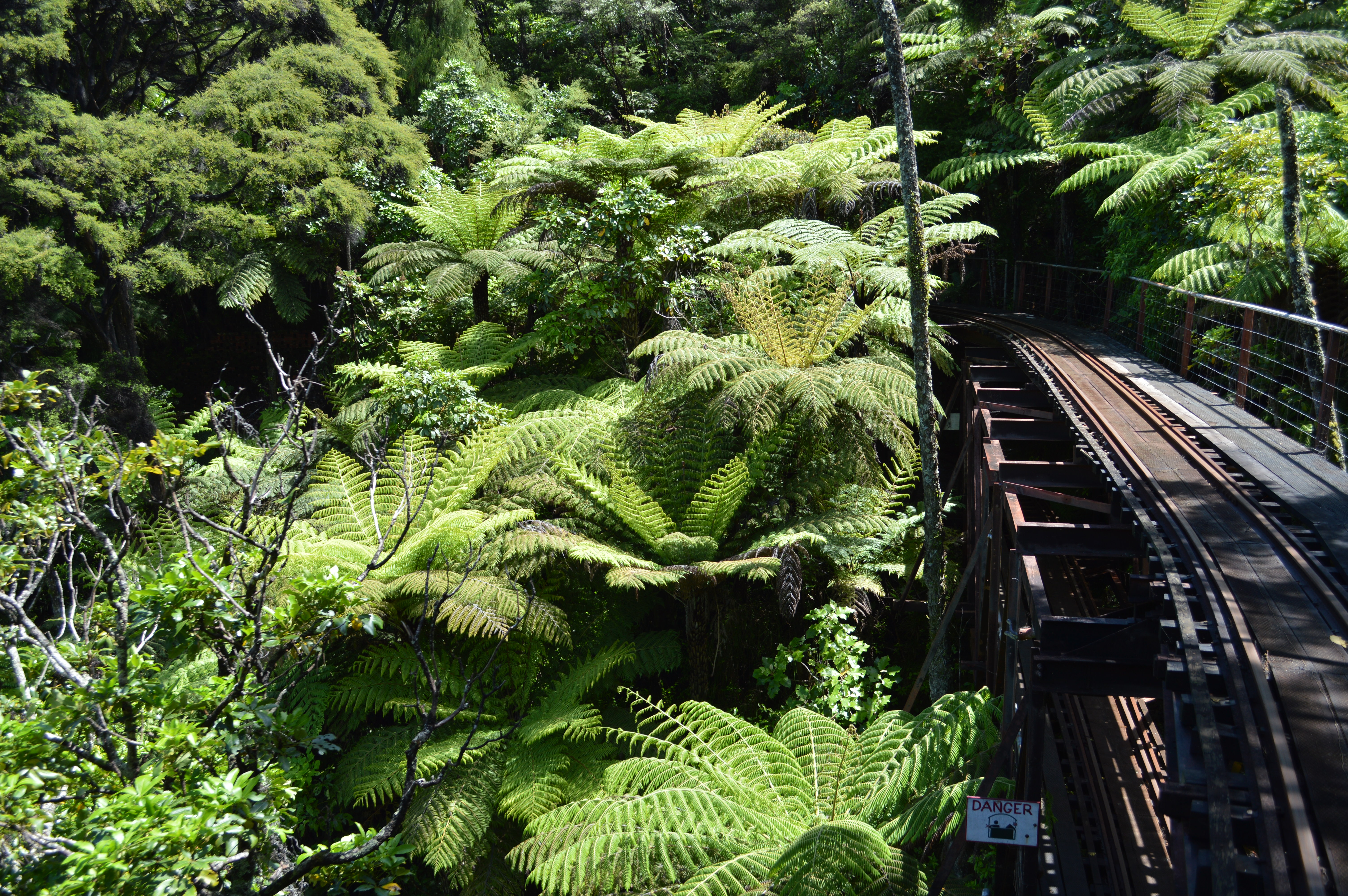
This tourist attraction shows just what one person with vision and determination can do. Barry started with the creation of his pottery. A wood-fired stoneware kiln was built. Clay used for potting was and is sourced from this property. He then started the railway, while at the same time putting in incredible efforts to restore the land to native bush. He has certainly succeeded with that. It's a wonderful fresh experience being in the little train as you wind through giant native trees and so many tree ferns. All planted by Barry. The environment has responded to Barry's care by completely regenerating for visitors' delight. I am grateful to see that with the right care, nature can come back within 30 years. Brickell said: "I wanted to demonstrate that you can have engineering in a rugged landscape and it could be good. Engineering doesn't have to be ugly."

The significant forest restoration includes a native wildlife sanctuary and a predator-proof fence. Possum trapping is on-going. I let out a cheer as we rattled past a possum hanging by its neck from a steel bar on a tree. Ecosystem 1, Aussie terrorist 0.

 Trees easily identifiable include Kauri, Rimu, Rewarewa, thousands of tree ferns including our NZ Silver Fern, all planted since 1973.

Potters visit from all over the world as studios and accommodation are available. While I was there a potting class was in progress. I watched in amazement as the most awesone teacher explained what and why he wanted them to do certain things. Concentrating on the 'feel' of what was happening inside their hands, the two students succeeded in turning the clay without unfortunate incidents. He was really awesome and I told him and his class so. You can see them in action. Barry Brickell was good at building kilns. There are several on site, many of them working.

Another feature of note during the train trip is the bottle retainer walls on the hilly sides. They look rather smart in the rain with the glass glistening. There are thousands used for these walls and the precision of placement is remarkable. Our driver told us that barry had put an ad out offering a free train ride to anyone with at least two dozen clean wine bottles to donate. This worked a treat and even today the train drivers are adding to the bottle walls with great pride. In fact, all along the train track passengers can see all sorts of whimsical pottery tucked in amongst ferns and streams. Tunnels are decorated with ceramics too. Each turn seems to have something fun to see, for the sharp-eyed.


Barry died in 2016 leaving the railway and its bush protected by a QE2 covenant. An additional activity onsite is a zipline canopy tour. it goes very fast and I think it's maybe too fast for tourists to get the feel of the bush while whizzing past it.

There's some really great further information here.. https://www.rnz.co.nz/news/national/294797/artist-barry-brickell-dies-aged-80

Driving Creek is now a fully charitable organisation and continues to deliver on Barry’s vision, as detailed in theTrust Charter. Driving Creek operates two charitable purpose programmes that stem from goals to:

  • Protect and enhance our natural environment, be a leader and centre for understanding and contribution to conservation initiatives, and share our conservation values with our community and visitors.
  • Be a leading centre for pottery and ceramic crafts where emerging potters are actively fostered and visitors share in a unique craft and creative experience.

Monday, 5 December 2022

Kaikoura's Classic Car Museum

I recently stumbled upon a little treasure in Kaikoura. Feeling in need of a quick bite we pulled up to Bernie's Diner. So much fun (the way Burger King was once in the long ago past), Every thing was American retro 60s at 105 Beach Rd. 

Ah, those milkshake containers, the little collection of mustard, tomato sauce and salt on each table. Spotless presentation and the service was faster than MacDonalds Matamata. I'd done my research and knew there was another even better reason to be here: Harmon's Classic Car Museum. It was created in 2017 by father and son Geoff and Bernard Harmon with their passion for cars. It remains a private collection.

I was delighted at the range and quality of models from the USA. The British cars were simply functional and boring though that's all that many of us Kiwis would have had experience of in our youth. The American cars were plastered with chrome, terrific upholstery, glam and certainly plenty of space. You'd never fit a parking space these days with those cars. 

Such big boots with luggage space, full size spare tyres you can easily get to, bench seats - younger generations will never know how exciting those could be. It was great to see under the hood of some of the models and be able to recognise various components. In my younger days I could change a tyre, change fuses and spark plugs, fill the radiator and window washer reservoir. Things look simpler now but in reality are much more complicated these days with everything dependent on electronics. 

Inside an annex were some interesting displays of unrestored cars, a classic caravan used back in the 60s and 70s, a huge stationwagon for beach holidays complemented with a diorama, a boat and even old petrol pumps. I still remember my father filling up the car with Caltex boron. Nothing lead-free back then. My parents started out with an old Singer and then progressed to Mum having a Humber and Dad a Mark 4 Zephyr. Alas the Zephyr rolled with a caravan during high winds on a hilly road while my parents were on holiday and was badly damaged. My father, who was driving, was quite battered too but cars were pretty solid in those days. He drove it home with a stoved in roof and the windscreen held to the car by ropes. 

 American cars were hard to come by so NZ was pretty much British automobiles until Japanese imports made their presence felt and greater reliability was a blessing, along with the reduced price tag.

There were additional items included in the museum: old petrol-powered bikes from the 20s, a Vespa scooter, a beautiful terracotta-coloured bike with sidecar and old traffic cop bikes. These were before the traffic division was assimilated by the police. Honda was the preferred brand and I remember them well though I never had any 'personal' dealings with them.

In a side wing could be found a Trash Fashion display of some of the winning entries since 2001. Trash Fashion is Kaikoura's premier entertainment event. The outfits are all from recycled trash which might be toilet paper or aluminium can rings, fabric or plastic twisties for bread, to name a few elements.

The museum includes a scaled replica of the West End of the main street of Kaikoura as it was at least 70 years ago. Included are some of the important buildings that are now gone.

Once back in the diner you can buy car-centric merchandise.

I had a lot of fun here remembering my own past with cars and motorbikes, family jaunts and asociated other memories..

It's open 7 days a week for breakfast and lunch, doughnuts and milkshakes, burgers and coffee.   www.harmons.co.nz