Saturday, 21 January 2017

Shakespeare's Globe theatre - with a kiwi twist

At Southwark, on the banks of the Thames in central London is a modern reconstruction of the Globe Theatre, famous as a venue for Shakespeare's plays in the 16th and 17th centuries. In fact, the current version is only metres away from the site of the original Globe.

It's as faithful a reproduction as they can get, working from available records and it houses a small museum and gift shop. It really is worth a visit and if you are staying a few days it's worth considering attending a play there. I couldn't as my time was spoken for and the plays on offer weren't my favourites but the guided tour was very interesting.

On 29 June 1613 the Globe Theatre went up in flames during a performance of Henry VIII. A theatrical cannon, set off during the performance, misfired, igniting the wooden beams and thatching.
The Globe was closed down by the Puritans in 1642. It was demolished in 1644-45 to make way for tenants.

Today it is the only building in central London permitted to have a thatched roof, which is hardly surprising given the way the orginal was destroyed and then the Great Fire of London of 1666 which spread from thatched roof to thatched roof and burned for three days.

This  reconstruction of the theatre, named "Shakespeare's Globe", opened in 1997, with a production of Henry V. It is an academic approximation of the original design, based on available evidence of the 1599 and 1614 buildings, and is located approximately 230 m from the site of the original theatre.
 Many of its patrons would have stood for the entire performances (lasting hours) or hired cushions for the ground or wooden benches back in Shakespeare's day. He was one of a handful of men who had shares in the theatre and most of his more popular plays were performed there. He was also an actor. The circular form gives good sight-lines in most cases and the acoustics are good.

In 2010 the Play Henry VIII was once again performed here but this time there were no fires. The rebuilding of the iconic building stems from the founding of the Shakespeare's Globe Trust by the pioneering American actor and director Sam Wanamaker. He died just short of seeing his project completed.

I enjoyed the museum. It shows a timeline of Shakespeare's achievements along with historical events. There is also a lovely display of typical Elizabethan clothing, including fotheringays, genuine musical instruments from this period and vocabulary created by the bard which have entered into our vernacular. There are interesting models of London of the period as far as one can tell as 80% of the city was later destroyed.

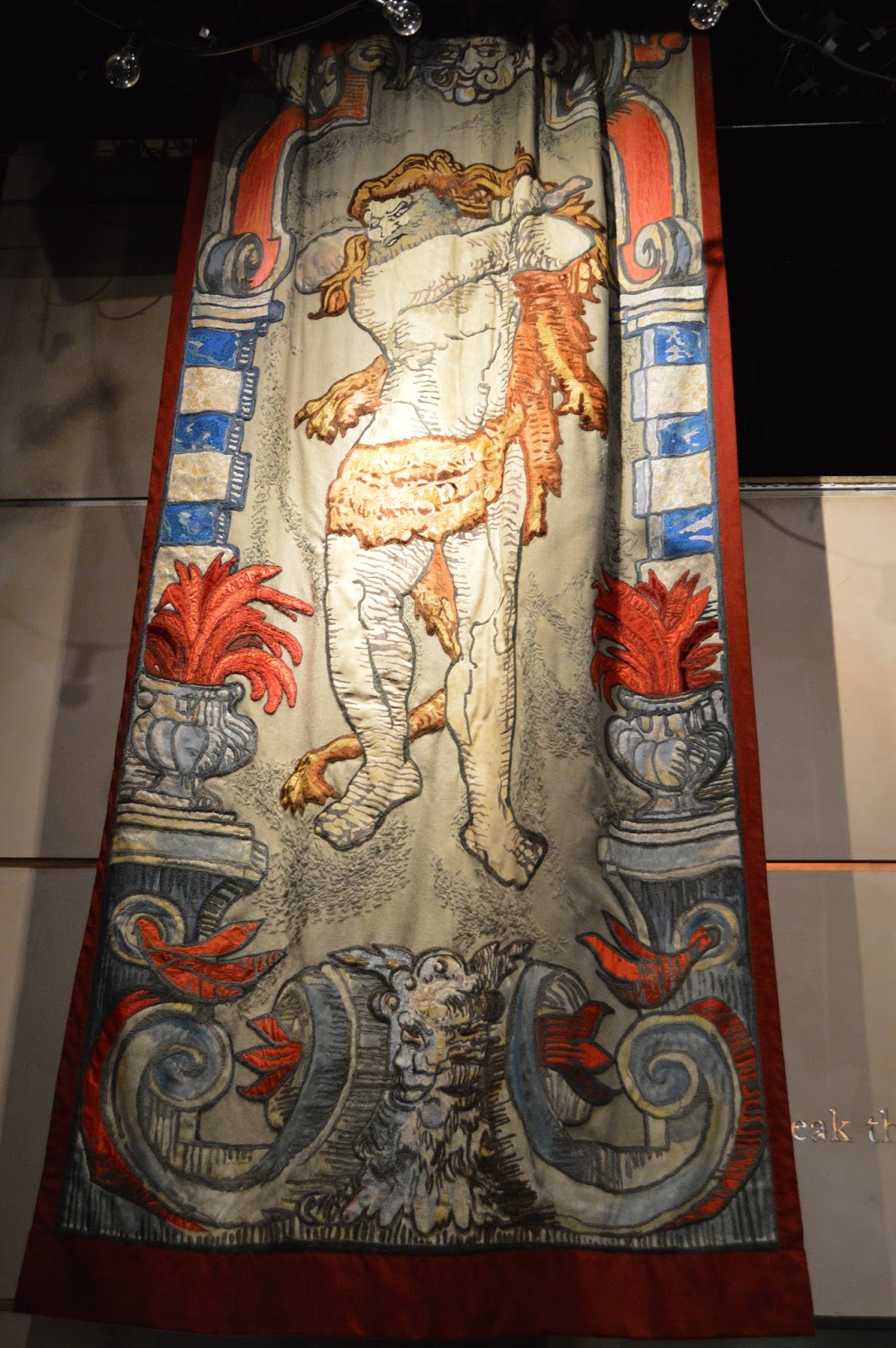
New Zealand has some truly passionate Shakespeareofiles. So much so that a group of embroiders and textile artists decided to create stage hangings for the new reconstruction. Ten years later and just in time for the official opening the four hangings were completed, toured a few countries and have found their home in the Globe's lower ground floor display area.

One of the hangings depicts Atlas holding up the world. New Zealand is clearly picked out in the embroidery even though in Elizabethan times NZ was unknown. Check out the photo below.


In February 2016, a temporary full-scale replica of the Second Globe Theatre, called Pop-up Globe and based on scholarly reanalyses of the surviving evidence for the 1614 building, opened in downtown Auckland, New Zealand and presented a three-month season of Shakespeare's plays performed by a house company.


Wednesday, 11 January 2017

Warwick Castle - lively history on the Avon

Inside some of us there is someone who dreams of adventures, knights and history-making events. As a child I was far more interested in reading boys' adventure books than the prissy offerings for most girls so it's not surprising I enjoyed what this castle has to offer.

Time was limited duing my few days in England but at least I got to sample Warwick Castle which, these days, is well and truly set up to nourish such dreams in young and old alike.
This castle on the banks of the Avon River has 1100 years of history from when the daughter of Alfred the Great first built there until now when Merlin Entertainment purchased it from Madame Tussauds.


The Tussauds era is still evident as many manequins and set-pieces remain to illustrate moments and personnages in history including Winston Churchill, Henry VIII, and life in the Middle Ages.
I was impressed by the original carved panelling on one of the old bedrooms. It's so detailed and atmospheric.
Warwick Castle was owned by the Kingmaker Richard Neville during the Wars of the Roses until he was executed. It was in the Beauchamp family for generations before that and later the Grevilles, Dudleys, Plantagenets. There must have been a great amount of political and military intrigues happening within its walls - if only they could speak.

Warwick Castle is home to one of Europe's largest seige machines. It's an example of a Trebuchet which would have been used in laying seige to castles in former times. The day I was visiting I just managed to arrive at the clearing as staff fired a flaming ball high in the air. They only fire once, unfortunately; blink and you miss it and the audience is usually quite a distance away, for safety reasons.

Throughout the grounds there are activities for families, such as archery practice and watching the hunting birds performance. We were told that one experienced eagle decided not to follow instructions and return home. It decided to go hunting on it's own and found a sheep so from then on it couldn't be trusted. Its son is now performing on a 'short invisible leash of rules and disciplines'.

I enjoyed the costumed staff and watching various themed activities but there was no time to see all or do justice to anything. My advice would be to make a visit of almost a full day. It's accessible by train from London. You can stay overnight in a castle bedroom if you wish as the owners cater for accommodation, events and tourist events. They have different themed activities happening throughout so check out their website for specific details.
https://en.wikipedia.org/wiki/Warwick_Castle
https://www.warwick-castle.com/

You need to allow as much time exploring the inside of the castle as the exterior. There may be guided tours of the property but on my Marcus Evans day trip we were left to our own devices for 1.5 hours, hopelessly inadequate to see or appreciate much. I advise at least three hours there. You can always find find things to eat and buy.


Sunday, 25 December 2016

Hampton Court Palace - fit for Tudor aspirations

Some kilometres out of London is an ex-royal palace brimming with history and tales of notable monarchs such as Henry the Eighth. Built around 1515 by Thomas Wolsley, Archbishop and advisor to King Henry VIII it was gifted to the king in the hopes of renewing waning favour. It didn't work. Henry had him arrested and he died of natural causes before he could be executed. Hampton Court is one of only two remnants of more than 60 royal palaces and houses that were used by Henry in his day, which have survived. The second remnant being Lambeth Palace which isn't open to the public and which has little more than the gatehouse remaining.

It was here that Henry's only son was born and also here that his third wife Jane Seymour died after giving birth to the future Edward VI. The tudor influence has been greatly diminished by monarchs William and Mary who demolished half the Tudor palace before they died.

You can easily distinguish the two architectural styles; the Tudor in rose-red bricks with black markings and elaborate chimney stacks, and the Baroque in plain pink bricks with white details. Henry built a hammerbeam Great Hall which still stands today. It's wonderful to look up at the workmanship and imagine the Tudor goings-on during meal-times and events.


After Anne Bolyn was executed the king ordered any references to her expunged but in one corner of this place they missed one and you can clearly see the initials of Henry and Anne.  There's an astrological clock that was installed during Henry's time. Incredibly it still accurately works after 500 years. It shows the time, the phases of the moon, star signs and high tide at London Bridge near the Tower of London, a key royal residence. One can marvel at the quality of ancient technology.

None of Henry's gardens remain but there are knot gardens outside a Tudor wing in the style. It's more of a kitchen garden really. The other garden areas are more modern and impressive.
A horticultural oddity is The Great Vine, planted in 1769. Incredibly it still gives a good harvest of grapes which are sold at the palace. I can't vouch for the flavour though.


 The day I visited there was an exhibition of beautifully crafted objects in very fine white paper. Representations of food and table decorations as well as period costumes were displayed in several rooms. They were quite exquisite and I couldn't imagine how they had been crafted. The interiors of the palace have some impressive contents but it lacks charm for its sheer size. It's easy to get lost here so allow at least 2-3 hours to explore inside and out. For more information go to http://www.hrp.org.uk/hampton-court-palace/#gs.PD9eYZc and also https://en.wikipedia.org/wiki/Hampton_Court_Palace


Sunday, 18 December 2016

Windsor Castle: when the Queen's away


Windsor Castle is one of the most important secular historic buildings in Britain and is the largest inhabited castle in Europe. I thoroughly recommend a visit to see the exquisite interiors but be sure to pick a time when the Queen's not in residence. Tours are not available when she's home.
No photos may be taken inside the castle, which is such a shame as it's the interiors that mark this place out as first rate.

It's immaculate despite its age of almost a thousand years. It clearly benefits by being an official home of the Queen so it's kept in top condition. It's gone from being a fortress to a medieval hunting lodge to a baroque masterpiece and then  the focus of the British Empire. Now it's the home of the Royal Collection.

Around 1070 William the Conqueror constructed this (and the Tower of London among other fortifications) motte-and-bailey castle. It commands a ridge overlooking the Thames. The castle has been developed, modified, restored and modernised through the ages by the rulers of England. The artistry is amazing. The details, superb art collection and furniture left me truly impressed. It's as good, in its way, as Versailles and contains some items from the Louis XIV period in France which now only exist in England. Many wonderful items from French history have made their home at Windsor while their original homes have been destroyed or eliminated in France. The relative stability of the English monarchy (other than the time of Oliver Cromwell) has meant that so much history has been preserved in a continuous line. Queen Mary's dollhouse is an interesting item, faithful in its smallest detail with operating lighting and an elevator.


In 1992 there was a devasting fire which destroyed a large part of the castle. Fortunately most of the furniture and artworks had earlier been removed for safe keeping from the fire-ravaged area while renovations were being done. A careless workman had left a spotlight on which ignited a curtain above the altar in the Private Chapel. The fire gutted the wonderful Saint George's Hall and many other key rooms. They have, with British craftsmanship, been completely restored to the highest level. As I gazed around me all I could think of was "It's perfect."

Having been impressed by the beauty and quality of the interior I came to a crashing disappointment with the gardens. The only thing to say here is - boring. I could do so much better. There are very few flowers or garden beds. It's monotonous and shows no imagination at all, in my opinion. For a castle of this importance it doesn't hold a candle to Hampton Court Palace which is NOT these days a royal residence. A few roses, mostly all the same variety in a couple of beds doesn't do it for me.

The day I visited there was a display of vintage cars in the courtyard. I don't know why.

The town of Windsor is quaint and used to having important dignaries passing through.
Check out a detailed history at:
https://en.wikipedia.org/wiki/Windsor_Castle